
By Marina Jahan · Published: 21 November 2026 · Last reviewed: November 2026 · Rules for 2026/27
An invoice with no VAT on it is not always a mistake. Getting reverse charge VAT wrong is one of the most common VAT return errors we see, usually because a nil-effect entry is left off the return.
This guide explains how the VAT reverse charge UK rules work for overseas services, construction and specified goods, which boxes to use, invoice wording and MTD software set-up, with worked 2026/27 examples.
- Under the reverse charge, the buyer accounts for the VAT instead of the seller.
- Most VAT-registered buyers who can fully recover VAT end up with no net cost, but the entries must still appear on the return.
- The UK reverse charge covers services from overseas suppliers, construction services reported under CIS, and goods and services listed in Notice 735.
- Businesses that are not VAT registered must count reverse-charge services from abroad towards the VAT registration threshold.
- Cash accounting cannot be used for reverse charge supplies, and Flat Rate Scheme users account for them outside the scheme.
What Is Reverse Charge VAT?
In a normal sale, the supplier charges VAT and pays it to HMRC, and the customer reclaims it as input tax.
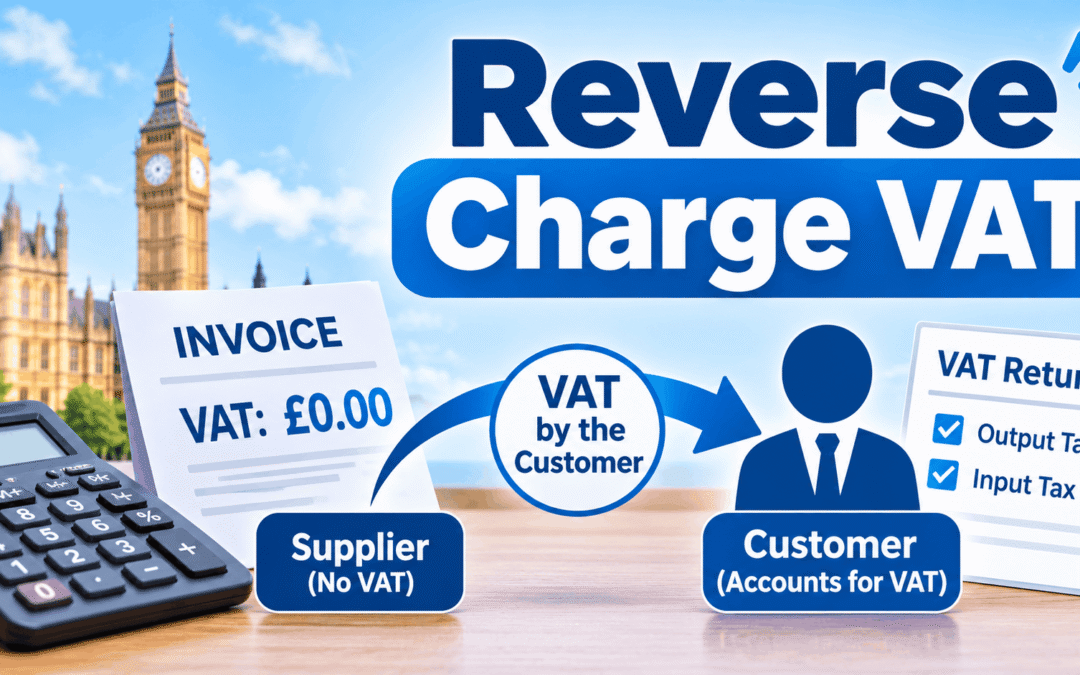
The reverse charge cuts out the first step. The supplier charges no VAT. Instead, the customer works out the VAT that would have been charged and puts it on their own VAT return twice: once as VAT due (output tax) and once as VAT reclaimed (input tax). For a fully taxable business, the two entries cancel out.
HMRC uses it to stop fraud where a seller collects VAT and disappears, and because a UK buyer is easier to reach than an overseas supplier with no UK presence.
“Reverse VAT” and “VAT reversal” mean the same.
When the VAT Reverse Charge Applies in the UK
The VAT reverse charge only applies in set situations, each with its own HMRC guidance.
| Situation | Who accounts for the VAT | Main HMRC guidance |
|---|---|---|
| A UK business buys services from a supplier based outside the UK (for example software, online advertising or consultancy) | The UK business customer | VAT on services from abroad and Notice 741A |
| A VAT-registered contractor buys standard or reduced-rated building work reported under CIS | The contractor (customer), unless it is an end user or intermediary | VAT reverse charge technical guide |
| A business buys specified goods or services such as mobile phones and computer chips (£5,000 or more), wholesale gas and electricity, wholesale telecoms or emissions allowances | The business customer | Notice 735 |
These are three separate sets of rules. The domestic reverse charge for construction and specified goods has its own conditions, and it generally does not apply to sales to consumers or non-business customers, or where those conditions are not met. Services from overseas suppliers are tested separately under the place of supply rules. Imported goods fall under import VAT or, where eligible, postponed VAT accounting, not the domestic reverse charge.
Reverse Charge on Services Bought From Abroad
Reverse charge VAT on overseas services follows the place of supply rules. Most business-to-business services are treated as supplied where the customer belongs, so when a UK business buys one from an overseas supplier, the UK customer accounts for the VAT. Examples include cloud software and online advertising.
You convert the invoice value into sterling, work out the VAT at the UK rate for that service, and enter it as both output tax and input tax. Use an appropriate exchange rate for the tax point, following HMRC’s currency conversion rules. For land-related and other unusual services, check Notice 741A.
Priya, a VAT-registered web designer, receives a £1,000 bill from a US software company with no VAT on it. VAT at 20% is £200.
On her VAT return she enters £200 in box 1 and £200 in box 4. She adds the £1,000 net value to box 6 and box 7, as Notice 700/12 requires for services from abroad. Her net VAT on the bill is £0.
If you are partly exempt
A business making some exempt supplies, such as certain financial or insurance services, may not reclaim all its input tax. The full VAT goes in box 1, but only part can be reclaimed in box 4, so the reverse charge creates a real cost.
Assume a business can recover 40% of its input tax under its approved partial exemption method. This is an example rate, not a standard HMRC figure. It buys the same £1,000 service from abroad, enters £200 in box 1 but only £80 in box 4, and bears a real VAT cost of £120.
If you are not VAT registered
This trap catches many small businesses. HMRC’s manual VATPOSS14700 explains that services you receive from abroad count towards your taxable turnover for the registration test, if they would be taxable reverse charge services under the UK place of supply rules. You compare the total with the £90,000 threshold over a rolling 12 months. The test uses taxable turnover, not profit.
A sole trader who is not VAT registered has £85,000 of UK taxable sales in the last 12 months and has also bought £8,000 of online advertising from an Irish supplier, a service taxable in the UK under the reverse charge. Their turnover for the test is £93,000, over the £90,000 threshold, so they must register.
If you are close to the limit, read Eternity Accountants’ guide to the VAT registration threshold for 2026/27, and include overseas services in your monthly running total.
The Domestic Reverse Charge for Construction (CIS)
The domestic reverse charge for construction has applied since 1 March 2021. A VAT-registered subcontractor does not charge VAT to a VAT-registered contractor; the contractor accounts for it instead. According to the GOV.UK guidance for buyers, it applies when all of the following are true:
- the supplier and customer are both registered for VAT
- the payment is reported through the Construction Industry Scheme (CIS)
- the services are standard or reduced-rated, not zero-rated
- the customer is not an end user or intermediary supplier
An end user is a customer registered for VAT and CIS that receives the construction services for its own use and does not make an onward supply of them. An intermediary supplier is connected with an end user and supplies the services on to that end user. Depending on the facts, this can include some landlord and tenant arrangements or companies in the same group.
A customer that qualifies can tell the supplier in writing that it is an end user or intermediary supplier. Once it does, normal VAT applies instead of the reverse charge, and the supplier should keep the notice as evidence. Supplies of staff or workers by employment businesses are also outside the construction reverse charge.
There is also a 5% disregard, which is optional rather than automatic. If a single supply includes a minor element that would be reverse charged, and that element is 5% or less of the whole supply value, it can be disregarded and normal VAT charged. Both sides agree it at the start, using overall contract values, not each invoice. It does not apply where the main element of a single supply is zero-rated.
A VAT-registered subcontractor invoices a VAT-registered builder £10,000 for standard-rated work, of which £6,000 is labour. No VAT is shown on the invoice.
The subcontractor puts £10,000 in box 6 and nothing in box 1. The builder enters £2,000 in box 1, £2,000 in box 4 and £10,000 in box 7.
Separately, the builder makes a CIS deduction of 20% on the £6,000 labour, which is £1,200. The subcontractor receives £8,800, compared with £12,000 on a normal VAT invoice.
This assumes the subcontractor is registered for CIS at the standard 20% rate. Gross payment status means no CIS deduction, and an unregistered subcontractor may suffer 30%. CIS is calculated separately from VAT.
CIS and the reverse charge are different things. The CIS deduction is an advance payment of the subcontractor’s income tax or corporation tax. The reverse charge is about VAT. For the CIS side, see Eternity’s guide to the CIS tax return in the UK.
Specified Goods and Services (Notice 735)
Notice 735 lists other goods and services where the domestic reverse charge applies between UK VAT-registered businesses.
| Goods or services | Reverse charge since |
|---|---|
| Mobile phones and computer chips | 1 June 2007 |
| Emissions allowances | 1 November 2010 |
| Wholesale gas and electricity | 1 July 2014 |
| Wholesale telecommunications services | 1 February 2016 |
| Renewable energy certificates | 14 June 2019 |
The £5,000 de minimis limit, measured excluding VAT, applies only to mobile phones and computer chips, not to the other items in the table. It is tested using the invoice or qualifying single purchase order rules, not by adding together unrelated purchases. Below £5,000, normal VAT applies; at £5,000 or more, the whole value of those goods is reverse charged.
A retailer buys £4,800 of mobile phones. The supplier charges normal VAT of £960. On a later invoice for £5,200 of phones, the supplier charges no VAT, and the retailer accounts for £1,040 under the reverse charge.
How Does Reverse Charge VAT Work on Your VAT Return?
The customer follows these steps to fill in the reverse charge VAT boxes:
- Check that the reverse charge applies and that the invoice says so.
- Work out the VAT at the rate that would normally apply to the goods or services.
- Add that VAT to your output tax in box 1.
- Reclaim it as input tax in box 4, subject to the normal rules and any partial exemption.
- Enter the net value in box 7, and also in box 6 if the service came from abroad.
The table below sets out the entries described in VAT Notice 700/12.
| Situation | Who | Box 1 | Box 4 | Box 6 | Box 7 |
|---|---|---|---|---|---|
| Services received from abroad | Customer | VAT | VAT | Net value | Net value |
| Domestic reverse charge (construction, Notice 735) | Customer | VAT | VAT | Leave out | Net value |
| Domestic reverse charge | Supplier | No VAT | — | Net value | — |
Missed entries on an earlier return can usually be corrected on your next return if the net error is below the limits in VAT Notice 700/45. Larger errors, or deliberate ones, must be reported to HMRC separately.
What a Reverse Charge VAT Invoice Must Show
A reverse charge VAT invoice under the domestic reverse charge must include the normal VAT invoice details and clearly state that the reverse charge applies. It should show the amount of VAT the customer must account for, without adding it to the amount charged. If your software cannot show that amount, state the VAT rate and that the customer must account for the VAT to HMRC.
HMRC accepts wording such as “Reverse charge: VAT Act 1994 Section 55A applies”, “Reverse charge: S55A VATA 94 applies” or “Reverse charge: Customer to pay the VAT to HMRC”.
| Invoice line | What it shows |
|---|---|
| Supplier and customer details | Names, addresses and VAT numbers where required |
| Description | Second fix electrical work, Plot 4, November 2026 |
| Net amount | £10,000.00 |
| VAT rate | 20% |
| Reverse charge VAT amount | £2,000.00 (customer to account for it) |
| VAT charged to customer | £0.00 |
| Reverse charge statement | Reverse charge: Customer to pay the VAT to HMRC |
The £2,000 is not added to the amount the builder pays. Overseas suppliers will not use this wording, but you still apply the UK rules.
Reverse Charge VAT and the Flat Rate Scheme or Cash Accounting
According to the VAT reverse charge technical guide, you cannot use the Cash Accounting Scheme for supplies or purchases subject to the reverse charge. Account for them under the reverse charge rules, not on a cash-received or cash-paid basis. You can keep using cash accounting for your other eligible transactions.
If you use the Flat Rate Scheme and receive reverse charge supplies, account for them outside the scheme. You put the reverse charge VAT in box 1 and can normally reclaim the same amount in box 4 on the same return, subject to the normal input tax rules, including any partial exemption.
If you make sales under the domestic reverse charge, leave their value out of your flat rate turnover. Reverse charge sales and purchases are always kept separate from the flat rate calculation.
Because the scheme still blocks input tax on materials and overheads, it can suit subcontractors with mainly reverse charged sales less well. Eternity Accountants explains the scheme’s pros and cons in its guide to the VAT Flat Rate Scheme.
Subcontractors who receive no VAT from customers may reclaim more than they pay, so some ask HMRC for monthly returns to speed up repayments.
Setting Up Reverse Charge Codes in MTD Software
Under Making Tax Digital for VAT, your VAT return figures come from your digital records. A wrongly coded bill flows straight into the return. Most MTD-compatible packages, including those compared in our guide to MTD VAT software, have separate tax codes for each type of reverse charge.
- Use the correct reverse charge code for overseas services, so the software fills boxes 1, 4, 6 and 7.
- Use the domestic reverse charge code for construction and Notice 735 purchases, so box 6 stays empty on the customer side.
- As a subcontractor, use the reverse charge sales code, which puts the net value in box 6 only.
- Never post a reverse charge bill as “no VAT” or “outside the scope”.
- Check the VAT return preview before submitting, and compare boxes 1 and 4 with your reverse charge purchases.
Tax code names differ between software providers. Choose the code that gives the correct VAT return treatment for the transaction, not the one with the most likely name, and test the result in boxes 1, 4, 6 and 7 before you submit.
Common Reverse Charge Mistakes
| Mistake | What to do instead |
|---|---|
| A subcontractor charges VAT on a job that should be reverse charged | Issue a credit note and a new invoice with reverse charge wording |
| The customer leaves the entries off the return because the net is nil | Always enter the VAT in boxes 1 and 4 |
| CIS is confused with the reverse charge | Treat them separately: CIS is income tax, the reverse charge is VAT |
| End user status is not checked before invoicing | Ask the customer to confirm in writing at the start of the job |
| An unregistered business ignores overseas services | Include them in the registration turnover test |
Reverse Charge VAT: FAQs
What is reverse charge VAT in simple terms?
The buyer, not the seller, accounts for the VAT, recording it as both owed and reclaimed on their own VAT return.
Who pays the VAT under the reverse charge?
The customer accounts for it. A fully taxable business reclaims the same amount on the same return, so there is usually nothing extra to pay.
Does the reverse charge cost me anything?
Not usually, if you can recover all your input tax. It can create a real cost if you are partly exempt, because you cannot reclaim all of the VAT.
Which boxes do I use for reverse charge VAT?
As a customer, enter the VAT in boxes 1 and 4 and the net value in box 7. For services from abroad, also add the net value to box 6. As a supplier under the domestic reverse charge, enter the net value in box 6 only.
Do I charge VAT if the construction reverse charge applies?
No. You do not charge VAT, but the invoice states that the reverse charge applies and shows the VAT the customer must account for. You show the net value in box 6 of your own return.
Does the reverse charge apply to services bought from the EU?
Yes. Since Brexit, EU suppliers are treated like any other overseas supplier for business services.
Do reverse charge services count towards the VAT threshold?
Yes. If you are not VAT registered, services you receive from abroad under the reverse charge count towards your taxable turnover for the £90,000 registration test.
Can I use the Flat Rate Scheme with the reverse charge?
Yes. You can stay on the scheme, but reverse charge purchases are accounted for separately: you declare the output VAT and can normally reclaim the same amount on the same return, subject to the normal rules. Reverse charge sales are left out of flat rate turnover.
What should a reverse charge invoice say?
It should include the normal VAT invoice details, the VAT rate, the reverse charge VAT amount the customer must account for, no VAT charged, and a statement such as “Reverse charge: Customer to pay the VAT to HMRC”.
What if I got the reverse charge wrong on a past return?
Small errors can usually be corrected on your next VAT return. Larger or deliberate errors must be reported separately under VAT Notice 700/45.
Final Verdict on Reverse Charge VAT
Reverse charge VAT looks complicated, but the logic is simple: the buyer, not the seller, accounts for the VAT. Identify which type applies, use the right boxes, word your invoices correctly and set the right software codes. Most errors happen when a nil-effect entry is left off the return.
MTDFix can check your reverse charge entries before you submit.
Written by Marina Jahan from HMRC’s VAT notices 735, 700/12, 700/45 and 741A, the VAT reverse charge technical guide and HMRC’s internal manuals, as at 21 November 2026. Examples use invented names and a 20% VAT rate, and every figure has been recalculated. This is general information, not personal tax advice.
MTDFix is a trading name of Major Accountancy Ltd. Eternity Accountants, linked in this guide, is a sister accountancy firm.