
By Marina Jahan · Published: 17 November 2026 · Last reviewed: November 2026 · Rules for 2026/27, updated for Budget 2026
Owners often assume a building is either fully claimable or not at all. With capital allowances on buildings, the land purchase price gets nothing, the bricks and mortar get a slow 3% a year, but the systems hidden in the walls and ceilings can often be claimed in full in the first year. For commercial property capital allowances, splitting the cost correctly can make a difference of tens of thousands of pounds.
This guide covers the four tax parts of a building, the 2026/27 rates after Budget 2026, worked examples, landlords, buying and selling. For the wider capital allowances picture, including full expensing for companies, see Eternity Accountants’ guide to full expensing and capital allowances.
- Land never qualifies for capital allowances.
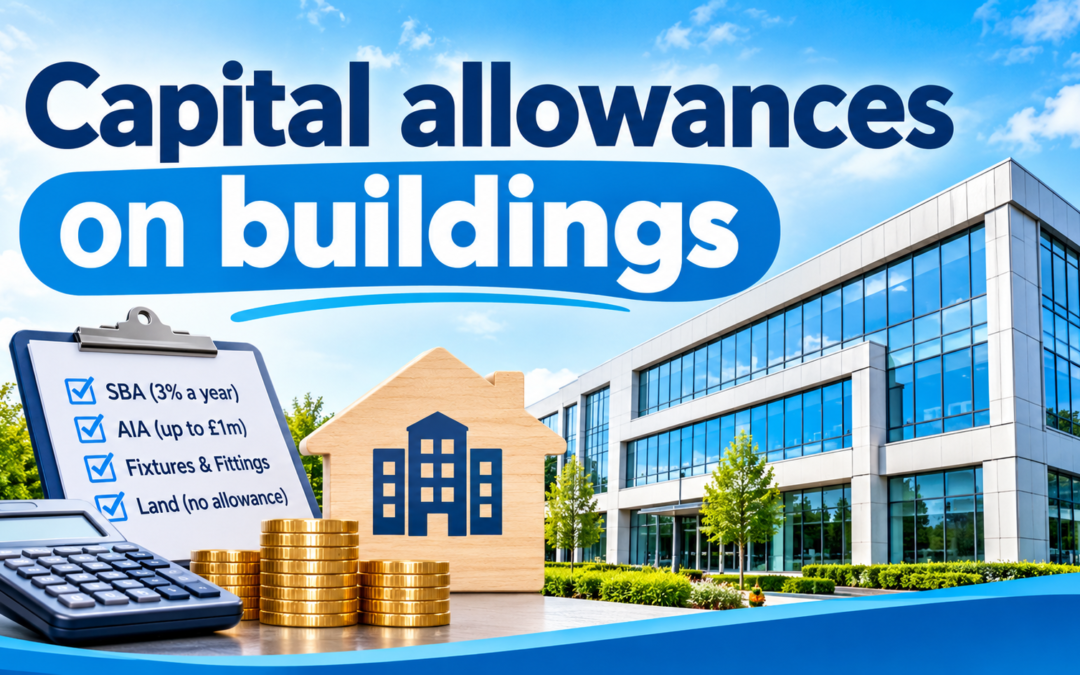
- The structure of a commercial building gets the Structures and Buildings Allowance (SBA) at 3% a year.
- Integral features and fixtures can qualify for the Annual Investment Allowance, giving 100% relief up to £1 million.
- Homes and the inside of residential lets get no capital allowances; landlords use other reliefs, and cash basis users follow different rules.
- Qualifying buildings in designated Freeport and Investment Zone tax sites may get an enhanced SBA of 10% a year.
- When you buy a used building, agree the value of the fixtures with the seller, or you may lose the allowances.
Capital Allowances on Buildings: The Four Parts of a Building
For tax purposes, a business building is a bundle of different assets, each treated differently. The purchase price or build cost is split into four parts:
| Part of the building | Examples | Allowance | How fast |
|---|---|---|---|
| Land | The land purchase price, landscaping, land reclamation | None | No capital allowance (the cost counts for capital gains) |
| Structure | Walls, roof, floors, windows, doors, stairs, site preparation for construction | Structures and Buildings Allowance | 3% a year over 33⅓ years |
| Integral features | Electrics and lighting, cold water, heating, air conditioning, lifts | Special rate pool, or AIA | 6% a year, or 100% with the AIA |
| Other fixtures and equipment | Items that may qualify as plant, depending on their nature and function | Main pool, AIA, full expensing or first-year allowance | 14% (12% from April 2027) a year, or up to 100% in year one |
The cost of preparing a site for construction, such as clearing and levelling, can form part of the SBA cost. Changing the land itself, such as landscaping or reclaiming land, does not. The bigger the share you can properly put into integral features and fixtures, the faster your relief. On a modern office or shop fit-out, that share is often substantial. Genuine repairs are a revenue cost, not a capital allowance.
Which Rates Apply in 2026/27 and 2027/28?
Budget 2026 changed two of the main capital allowance rates. HMRC published the details on 29 October 2026, and the changes are being legislated in Finance Bill 2026-27 (HMRC policy paper).
| Allowance | 2026/27 | From 2027 | Who can use it |
|---|---|---|---|
| Annual Investment Allowance (AIA) | 100% up to £1m a year | No change | All businesses; qualifying plant and machinery, new or used |
| Full expensing | 100% | No change | Companies only; new and unused main rate plant |
| Special rate first-year allowance | 50% | No change | Companies only; new and unused special rate plant |
| Main rate first-year allowance | 40% | 50% for spending from 1 Jan 2027 | All businesses; new main rate plant, not cars or second-hand assets |
| Main rate writing down allowance | 14% | 12% from 1 Apr 2027 (companies) / 6 Apr 2027 (others); hybrid rate for straddling periods | All businesses |
| Special rate writing down allowance | 6% | No change | All businesses |
| Structures and Buildings Allowance | 3% (10% in some special tax sites) | No change | All businesses with a qualifying interest |
You can only claim one allowance on the same spending: if you use the AIA, you cannot also claim a first-year allowance on that cost. Full expensing and the first-year allowances need the asset to be new and unused, so second-hand fixtures usually rely on the AIA or writing down allowances. Plant bought to lease out is generally outside full expensing but can qualify for the 50% main rate first-year allowance (GOV.UK: full expensing).
The main rate writing down allowance falls from 14% to 12%. An accounting period that straddles 1 April 2027 (or 6 April 2027 for sole traders and partnerships) gets a time-apportioned hybrid rate. The main rate first-year allowance rises from 40% to 50% for spending from 1 January 2027. The special rate and the SBA are unchanged.
The Structures and Buildings Allowance (SBA)
The SBA gives relief on the cost of constructing, renovating or converting a commercial building, at 3% a year on a straight-line basis (GOV.UK: structures and buildings). It applies to construction contracts entered into on or after 29 October 2018. The full relief therefore takes 33⅓ years.
- SBA for commercial buildings: offices, shops, factories, warehouses, workshops, hotels and other non-residential structures such as walls, bridges and car parks.
- When it starts: from the later of the date the building is first brought into non-residential use and the date the qualifying spending is incurred. In the first year, the allowance is time-apportioned, so you may get less than the full 3%.
- Excluded: land, the cost of buying land, and dwellings such as houses and flats. Mixed-use buildings are apportioned.
- Extensions and renovations: each new project gets its own 3% allowance over its own 33⅓ years.
- No double claims: anything claimed as plant, an integral feature or a fixture cannot also get the SBA.
To claim, the first owner must prepare an allowance statement showing the qualifying cost and the date the building was first used (Ross Martin). Later buyers need that statement too: without it, their qualifying cost is treated as nil. The allowance stops if the building is sold, demolished or no longer used for a qualifying activity (HMRC CA90000).
Enhanced SBA in Freeports and Investment Zones
Certain qualifying construction spending on buildings in designated Freeport and Investment Zone tax sites may qualify for an enhanced SBA of 10% a year over 10 years. The building must be in a qualifying site, used for qualifying purposes and brought into use within the relevant time limits, so check the conditions for your site before relying on it.
Integral Features and Fixtures: Where the Bigger Claims Are
Integral features
The law lists a specific set of integral features (CAA 2001 s33A): electrical systems including lighting; cold water systems; space or water heating, powered ventilation, air cooling and air purification; lifts, escalators and moving walkways; and external solar shading.
Integral features are special rate expenditure and go into the special rate pool at 6% a year (HMRC CA22300). However, they qualify for the AIA, so most small businesses can claim them in full in the year of spending. Companies can instead use the 50% special rate first-year allowance on new and unused integral features.
Capital allowances on fixtures
Other items, such as kitchen fittings, sanitaryware, fire alarms, CCTV, shelving and signage, may qualify as plant, depending on the nature of the asset. Whether something is plant or simply part of the building depends on its function, who owns it and how it is installed. A fitted kitchen in a staff room may qualify where a basic wall finish would not, so each item needs looking at on its facts.
Where an item is main rate plant, it can qualify for the AIA (GOV.UK: AIA), full expensing if a company buys it new, or the main rate first-year allowance, which rises to 50% from 1 January 2027. Anything left over goes into the main pool at 14%, falling to 12% from April 2027.
Worked Examples: A Company and a Sole Trader
The cost splits below are illustrative; a real split comes from the builder’s breakdown or a specialist survey.
| Item | Company: new office £600,000 | Sole trader: new workshop £400,000 |
|---|---|---|
| Land (no relief) | £150,000 | £100,000 |
| Structure: SBA at 3% | £300,000 → £9,000 | £220,000 → £6,600 |
| Integral features: AIA | £90,000 | £50,000 |
| Fixtures: AIA | £60,000 | £30,000 |
| Total allowances in year 1 | £159,000 | £86,600 |
| Illustrative tax saved in year 1 | £39,750 at 25% Corporation Tax | About £36,372 at 42% (40% tax plus 2% Class 4) |
In the company example, £150,000 of AIA covers the integral features and fixtures, and the £9,000 SBA assumes a full year of qualifying use. In the sole trader example, the £6,600 SBA also assumes a full year, and the £36,372 saving assumes a 42% combined rate of Income Tax and Class 4 on enough taxable profit to use the allowances.
These examples assume a full year of qualifying use, sufficient available AIA, no restriction from other spending and the ability to use the allowances against taxable profits. Actual tax savings depend on the business’s tax position, accounting period and qualifying expenditure.
Capital Allowances for Landlords
Capital allowances on buildings work very differently for residential and commercial landlords.
Residential property
You cannot claim the SBA on a house or flat, and you cannot claim plant and machinery allowances on items inside a dwelling, such as a boiler, a fitted kitchen or furniture. Instead, when you replace furniture, appliances or furnishings in a let home, you can usually claim replacement of domestic items relief (HMRC PIM3210). The first purchase of those items gets no relief.
The common parts of a block of flats are different. Shared areas such as corridors, stairwells and entrance halls are not part of any one dwelling, so equipment there, like communal lighting, door entry systems or a lift, can qualify for plant allowances.
Commercial property
If you let a shop, office or industrial unit, you can claim the SBA on construction or renovation costs and plant allowances on fixtures you own, as long as the tenant is not claiming the same items.
The cash basis
Many smaller landlords use the cash basis, where the rules work differently (HMRC PIM1095):
- capital spending can often be deducted as an expense, but there are extensive exceptions;
- no deduction is given for non-depreciating assets, and an asset generally counts as depreciating if it is expected to last 20 years or less, or to lose at least 90% of its value within 20 years;
- no deduction is given for the building itself, such as walls, floors, windows or stairs;
- cars are never deducted under the cash basis, so capital allowances still apply to them;
- capital spending on ordinary residential property is restricted, though replacement of domestic items relief may apply.
Buying a Second-Hand Building
When you buy a used commercial building, you take over the remaining SBA and you can usually claim allowances on the fixtures, but only if the paperwork is right.
- Ask for the SBA allowance statement. It shows the qualifying cost and the date of first use, so you can continue claiming 3% a year.
- Check the pooling requirement. If the seller could have claimed allowances on the fixtures, they must have added that spending to their pool before the sale. If they did not, you may be unable to claim at all.
- Agree a fixtures value. Buyer and seller must fix the value of the fixtures, normally with a section 198 election made within two years of the transfer, or by starting tribunal proceedings within that time. Without either, you may lose the allowances.
- Stay within the limits. The value in the election cannot exceed the seller’s original qualifying cost or the actual sale price.
- Use the CPSE questions. The standard pre-contract enquiries cover capital allowances, so raise them early through your solicitor.
Full expensing does not apply to second-hand fixtures, but the AIA does. For larger purchases, a capital allowances survey by a specialist can identify qualifying items hidden in the price. Eternity Accountants also works with property tax accountants on purchases like these.
Selling a Building: What Happens to Your Allowances?
The SBA and plant allowances behave differently when you sell.
- SBA: your allowance stops when you sell, and there is no balancing adjustment. The buyer carries on claiming. The SBA you have claimed is usually added to your disposal receipts when working out your capital gain or loss.
- Fixtures and integral features: the value agreed in the section 198 election is your disposal value. If it is more than the remaining pool, you get a balancing charge.
The company that built the £600,000 office has claimed £9,000 of SBA a year for five years, a total of £45,000. When it sells, that £45,000 is usually added to its disposal receipts, so its chargeable gain is £45,000 higher, or its loss £45,000 smaller. If the extra gain is taxed at 25%, the illustrative tax impact is about £11,250. The actual effect depends on the company’s overall gain or loss on the sale.
Working From Home and Other Sole Trader Cases
If you run your business from home, you cannot claim capital allowances on the house itself, even on the room you use as an office. Instead, you claim a share of household running costs as use of home expenses.
Equipment you buy for the business, such as a desk or computer, can qualify for the AIA, and a separate workshop used only for business may qualify for the SBA.
Records, Tax Returns and MTD
To support a claim for capital allowances on buildings, keep:
- the contractor’s cost breakdown or a specialist surveyor’s report splitting the spending
- the SBA allowance statement, whether you prepare it or receive it from a seller
- any section 198 election and the contract showing the price split
- dates the building and its fixtures were first used
Companies claim in the Corporation Tax return. Sole traders, partnerships and landlords claim on their Self Assessment return. If you are within Making Tax Digital for Income Tax, record the spending in your software as it happens, but capital allowances are normally finalised at the year end. For other assets, see our guide to capital allowances on electric cars.
Common Mistakes With Capital Allowances on Buildings
| Mistake | What to do instead |
|---|---|
| Claiming allowances on the land | Exclude the land value from every claim |
| Claiming the SBA on a house or flat | The SBA covers non-residential buildings only |
| Putting the whole cost into the SBA | Split out integral features and fixtures for faster relief |
| Missing the section 198 election | Agree the fixtures value within two years of the sale |
| Buying without an allowance statement | Ask the seller for it before completion |
| Using 14% for periods after April 2027 | Use 12%, or a hybrid rate if your period straddles the change |
| Treating repairs as capital | Deduct genuine repairs as an expense instead |
Capital Allowances on Buildings: FAQs
Can you claim capital allowances on buildings?
Yes, in part. The structure of a commercial building qualifies for the Structures and Buildings Allowance at 3% a year, and integral features and fixtures inside it can qualify for faster allowances.
Can I claim capital allowances on land?
No. Land never qualifies for capital allowances. Its cost only counts when you work out a capital gain on sale.
What is the Structures and Buildings Allowance rate?
It is 3% a year on a straight-line basis over 33⅓ years. Some buildings in Freeport and Investment Zone tax sites may qualify for 10% a year over 10 years.
Can landlords claim capital allowances on residential property?
Not on the property itself or items inside a dwelling. Landlords can usually claim replacement of domestic items relief, and allowances may apply to the common parts of a block.
What are integral features?
They are a set of building systems listed in the law, including electrics and lighting, cold water, heating, air conditioning, lifts and external solar shading.
Can I claim capital allowances on a commercial property I buy?
Usually yes. You can continue the seller’s SBA with an allowance statement and claim fixtures if the seller pooled them and you agree their value, usually with a section 198 election.
What is a capital allowances survey?
It is a review by a specialist, usually a surveyor, that identifies the qualifying plant, integral features and SBA cost within a property purchase or building project.
What is a section 198 election?
It is a joint election by the buyer and seller fixing the value of fixtures in a property sale. It must normally be made within two years of the sale.
What happens to capital allowances when I sell a building?
Your SBA stops, with no balancing adjustment, and the SBA claimed is usually added to your disposal receipts for capital gains. Fixtures can create a balancing charge.
Do the 2027 rate changes affect buildings?
Yes, for fixtures in the main pool, which fall from 14% to 12% from April 2027. The SBA stays at 3% and the special rate stays at 6%.
Final Verdict on Capital Allowances on Buildings
The land gets nothing and the structure gets a slow 3% a year, so the real value lies in the integral features and fixtures. Get a proper cost split, use the AIA where you can, keep the allowance statement and fixtures paperwork safe, and plan for the April 2027 rate change.
MTDFix can split your building costs and claim the right allowances.
Written by Marina Jahan from GOV.UK guidance, HMRC’s 29 October 2026 policy paper (Finance Bill 2026-27), the Capital Allowances Act 2001 and HMRC’s Property Income Manual, as at 17 November 2026. Examples are illustrative and were calculated in code. This is general information, not personal tax advice.
MTDFix is a trading name of Major Accountancy Ltd. Eternity Accountants, linked in this guide, is a sister accountancy firm.