
By Marina Jahan ·
Reviewed by Shamayun Chowdhury, CIMA ·
Tax year 2026/27 · Last reviewed [22 September 2026]
Quick answer
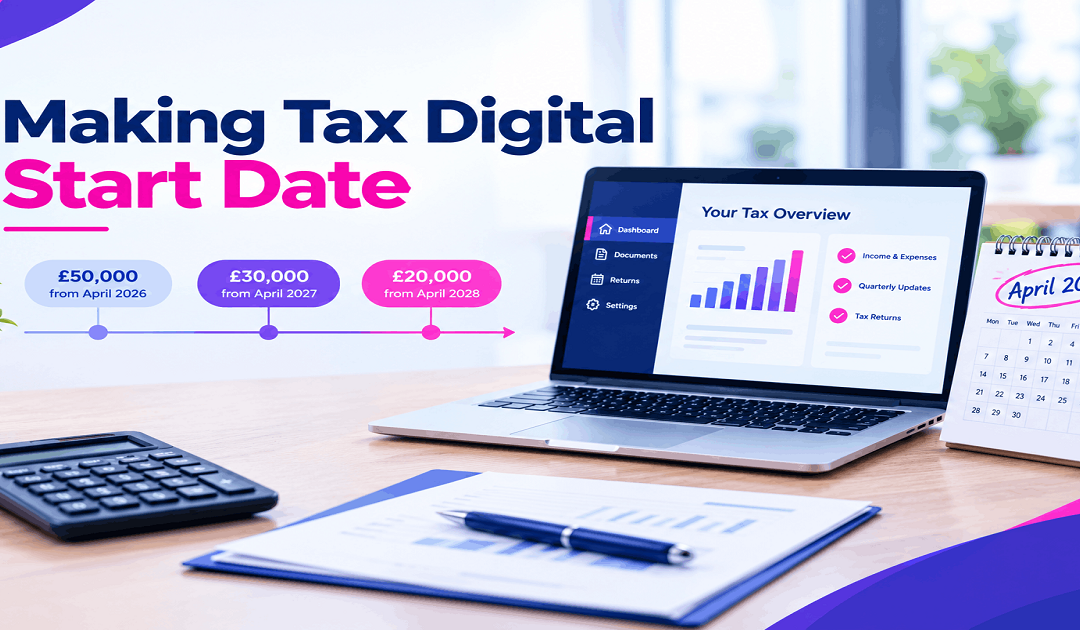
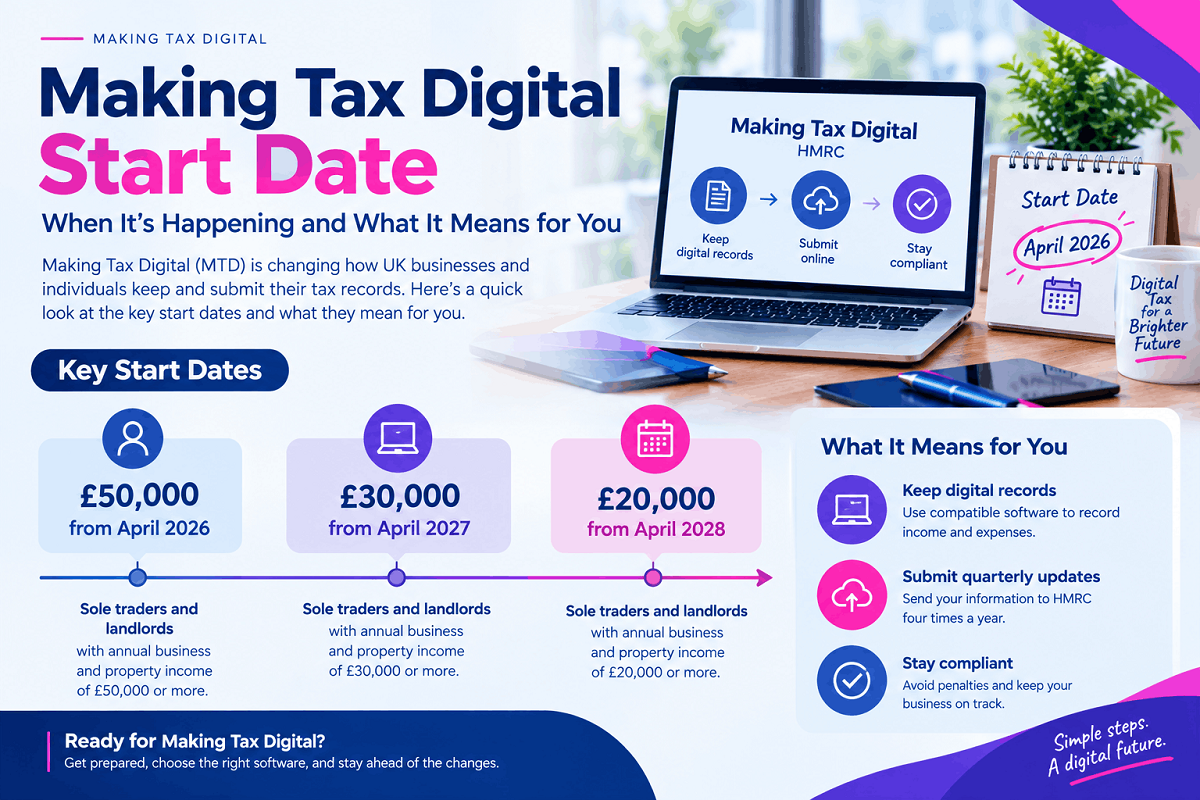
There is no single Making Tax Digital start date. VAT-registered businesses joined years ago, in 2019 and 2022. For Income Tax, your date depends on your gross trade and rental income: 6 April 2026 above £50,000, 6 April 2027 above £30,000, and 6 April 2028 above £20,000. Once you are in, five dates matter each year, four quarterly and one annual.
Find your Making Tax Digital date
| Your income | Tax return HMRC checks | Making Tax Digital start date |
|---|---|---|
| VAT registered, any turnover | n/a | Already in, since 1 April 2022 |
| VAT registered above the old £85,000 threshold | n/a | Already in, since April 2019 |
| Gross trade + rent over £50,000 | 2024/25 | 6 April 2026 |
| Gross trade + rent over £30,000 | 2025/26 | 6 April 2027 |
| Gross trade + rent over £20,000 | 2026/27 | 6 April 2028 |
| Gross trade + rent £20,000 or less | any | No date yet |
| General partnership | n/a | No date announced |
| Limited company (Corporation Tax) | n/a | Not going ahead |
The pattern is worth noticing. Your Making Tax Digital date is set by a return you filed months earlier, not by what you are earning today, and it always falls on 6 April. The full Making Tax Digital timetable sits further down this page.
When does Making Tax Digital start for you? Three answers, one per tax
Making Tax Digital when does it start? There is no single answer, because VAT and Income Tax run to separate calendars. Ask “making tax digital when do I need to start” and the reply depends entirely on which of the two you mean.
When does Making Tax Digital start for sole traders? April 2026 onwards
Sole traders came in with the first Income Tax wave on 6 April 2026, provided the 2024/25 return showed gross sales plus any rent above £50,000. If it showed more than £30,000, the making tax digital self employed date is 6 April 2027. Below £20,000 and no date applies yet.
Nothing about the trade itself changes the answer. A plumber, a driver and a copywriter with identical turnover all start on the same day. Our page on Making Tax Digital for sole traders goes into the day-to-day detail.
When does Making Tax Digital start for landlords? Same dates, one twist
Landlords follow the same timetable, with one difference that catches people out: rent counts in full, before mortgage costs, agent fees or repairs. A landlord with £52,000 of rent and very little profit joined in April 2026 all the same.
Joint owners are tested on their own share, so a couple splitting £60,000 of rent are at £30,000 each and both fall into the April 2027 group. See our page on HMRC landlords Making Tax Digital.
When does Making Tax Digital for Income Tax start if you do both?
The two figures are added together. Trade income of £24,000 with rent of £19,000 comes to £43,000, which is over the £30,000 limit, so the start date is 6 April 2027. Plenty of people who are comfortably under the line on each source separately are over it combined. Our page on the Making Tax Digital thresholds sets out exactly what counts.
The Making Tax Digital VAT start date
VAT went first. Businesses trading above the VAT registration threshold were the original intake, from April 2019: digital records, and returns sent straight from software. Three years later, on 1 April 2022, the net widened to every VAT number in the country, voluntary registrations included.
So when did Making Tax Digital start, in the widest sense? April 2019. When did HMRC make tax digital for Income Tax? 6 April 2026, seven years later and after several delays.
When do I need to start Making Tax Digital? Two boxes on your last return
Take the gross sales and gross rent boxes from your most recent tax return, add them, and read the table above. If you are still unsure, send us those two figures and we will confirm your date.
Your Making Tax Digital deadlines once you are in
Every deadline for Making Tax Digital sits on a fixed date: five a year, and the HMRC Making Tax Digital deadlines below do not move. Miss one make tax digital deadline and the clock simply runs to the next. The quarterly updates fall on the 7th, not the 5th, whatever you may have read elsewhere.
| Period covered | Quarterly update due |
|---|---|
| 6 April to 5 July | 7 August |
| 6 July to 5 October | 7 November |
| 6 October to 5 January | 7 February |
| 6 January to 5 April | 7 May |
| Whole tax year (tax return) | 31 January after the year ends |
Source: HMRC’s penalty guidance on GOV.UK.
The MTD reporting deadline in practice
Each quarterly update is a running total from 6 April, so quarter three covers April through early January rather than October to January alone. Any figure you corrected since the last submission is carried in automatically.
Run more than one business, or a business plus rental property, and each one needs its own update. They all share the same date, which keeps the diary simple even when the workload doubles.
Making Tax Digital submission dates if you prefer calendar months
Periods ending on 5 July and 5 October suit nobody’s bookkeeping. Electing for calendar quarters moves those period ends to 30 June, 30 September, 31 December and 31 March, while 7 August, 7 November, 7 February and 7 May stay exactly where they are.
Two conditions apply. The switch happens inside your software, and it has to be done before quarter one is submitted. After that you are fixed until the following April.
Payment dates are not changing
None of the five filing dates is a payment date. Income Tax is still collected on 31 January, with a second payment on account on 31 July where those apply to you. HMRC deadlines for Making Tax Digital govern reporting; the money leaves on the old Self Assessment schedule.
The year you join: two systems at once
Your first Making Tax Digital year comes with a quirk worth planning for. You are reporting quarterly under the new rules while still finishing the previous year under the old ones.
Take someone whose first year began in April 2026:
7 August 2026 — quarter one of 2026/27 goes in
7 November 2026 — quarter two follows
31 January 2027 — the 2025/26 return, filed the old way, and the tax on it
7 February 2027 — quarter three, landing a week later
7 May 2027 — quarter four closes the year
31 January 2028 — first tax return filed through MTD software, for 2026/27
January is the pinch point. The 2025/26 return lands on the 31st and the third quarterly update follows on 7 February, so the two jobs sit a week apart. Getting the quarterly figures ready before Christmas takes the pressure off both.
One change to note for the following year: once you are inside the rules, the year-end return leaves your software, not HMRC’s website. The 2025/26 return can still go in the old way; the 2026/27 one cannot.
The Making Tax Digital timeline, 2015 to 2028
Few tax reforms have moved as often as this one, and the Making Tax Digital timeline HMRC publishes has been rewritten more than once. The HMRC Making Tax Digital timeline below, the schedule HMRC has actually worked to, sets out the full Making Tax Digital roll out: what was announced, what slipped, and what finally happened.
| Date | What happened | Status |
|---|---|---|
| 2015 | Government announces the end of the annual tax return and a digital tax account for every business | Announced |
| April 2019 | MTD for VAT becomes compulsory above the VAT registration threshold | Done |
| 2019 to 2021 | Soft landing on digital links, extended through the pandemic | Done |
| April 2021 | Soft landing ends. Every link in the chain must be digital, so copy and paste is out. Often called Making Tax Digital VAT phase 2, or simply Making Tax Digital phase 2 | Done |
| September 2021 | Income Tax legislation laid, with a start date of April 2024 | Announced |
| 1 April 2022 | MTD for VAT extended to all VAT-registered businesses, whatever the turnover | Done |
| December 2022 | Ministerial statement delays Income Tax by two years to April 2026 and drops the £10,000 threshold plan | Delayed |
| November 2023 | Small business review reports; the design is simplified and smaller businesses are left out for now | Reviewed |
| Spring 2025 | Government confirms a third phase at £20,000 from April 2028 | Announced |
| July 2025 | HMRC’s Transformation Roadmap confirms Corporation Tax will not join | Dropped |
| 6 April 2026 | MTD for Income Tax goes live above £50,000 | In force |
| September 2026 | HMRC begins signing up people who should already be registered | Under way |
| 6 April 2027 | Threshold falls to £30,000 | In law |
| 6 April 2028 | Threshold falls to £20,000 | In law |
Why the Making Tax Digital roadmap kept moving
Three reasons, broadly. The original plan was far more ambitious than the systems could support; the pandemic pushed HMRC’s priorities elsewhere; and professional bodies pushed back hard on the cost of quarterly reporting for very small businesses. Each round of pressure produced a delay, a higher threshold, or both.
The programme that arrived in 2026 is smaller than the one announced in 2015. Corporation Tax is out, partnerships have no date, the £10,000 threshold became £50,000, and the end of the tax return never happened.
Making Tax Digital update: what is current as of 2026
Search for Making Tax Digital 2023, Making Tax Digital 2024 or Making Tax Digital 2025 and you will still find pages presented as current. Check anything of that age against this timeline. A great deal of that material says Income Tax starts in April 2024, or that the threshold is £10,000, or that MTD applies only to VAT. All of it was true once. None of it is true now.
Has Making Tax Digital been delayed, postponed or scrapped? The record
Short answer: every Making Tax Digital delay is now history. It was postponed repeatedly, and then it happened.
Will Making Tax Digital be scrapped?
No sign of it. The Income Tax rules are in force, the 2027 and 2028 thresholds are written into the 2026 regulations, and HMRC is actively enrolling people who have not registered. Campaigns to have it dropped have not changed the position.
The part that was scrapped is the Corporation Tax stage; that is the only piece of Making Tax Digital scrapped so far. HMRC confirmed in July 2025 that it does not intend to introduce Making Tax Digital for Corporation Tax, which is why limited companies file as they always have.
Has Making Tax Digital been postponed again?
Will Making Tax Digital be delayed again? Not since December 2022, when this Making Tax Digital income tax delay moved the start date from April 2024 to April 2026. No date has shifted since, and that final postponement came with three years of warning. The dates have held ever since.
Will there be a Making Tax Digital deadline extension?
No Making Tax Digital deadline extension has been granted, no Making Tax Digital extension is expected, and no Making Tax Digital deadline extended the timetable after 2022. What does exist is a softer first year:
- No penalty points for late quarterly updates during 2026/27, for the April 2026 group only. The updates must still be sent before your tax return.
- In your first year under the new penalty system, you get thirty days to settle the tax before a late payment charge begins, rather than the usual fifteen. That longer window is a one-off.
Neither is a deadline extension. The dates are unchanged; the consequences are simply lighter for one year. Source: HMRC’s penalty guidance on GOV.UK.
Is Making Tax Digital going to happen for everyone?
Not on current plans. People with gross trade and rental income of £20,000 or less have no date. Partnerships have none either. And employees, pensioners and company directors drawing salary and dividends are outside the Income Tax rules altogether.
What happened to the Making Tax Digital pilot
Long before the rules bit, HMRC ran a Making Tax Digital pilot scheme: a small group of volunteers filing quarterly updates through early software while the systems were tested. It ran for years, stayed small, and quietly widened as each delay pushed the start date back.
The pilot in that sense is over, but volunteering is not. You can still join Making Tax Digital for Income Tax before your mandatory date if you meet HMRC’s conditions for volunteers. Two reasons make it worth considering: your income is heading over the threshold anyway, or you would rather learn the software in a year when the stakes are lower. Bear in mind that volunteers come under the new penalty rules too, so it is a commitment rather than a trial run.
Missed a deadline? What happens after the date
File the missing update anyway, and file it now. MTD after deadline problems compound quietly: HMRC will not accept your tax return until every quarterly update for that year has been sent, so a gap from August resurfaces the following January when there is no time to fix it.
Where you stand depends on the year:
- 2026/27, April 2026 group. No penalty points for late quarterly updates. The obligation stands, but the record stays clean.
- 2027/28 onwards. Each missed deadline adds a point. Four points brings a £200 penalty, and another £200 follows each further miss.
- The tax return itself. Never covered by the easement. A late return earns a point in any year.
- Late payment. Charged separately, with interest running from the day after the due date.
Catching up in order is the quickest route: oldest missing update first, then each later quarter, then the return. Our page on Making Tax Digital penalties covers how points build and clear.
Making Tax Digital VAT deadlines, briefly
VAT runs on its own calendar, unchanged by the Income Tax rules. For most businesses the return and the payment are both due one calendar month and seven days after the VAT period ends, so a quarter ending 31 March is due by 7 May. Monthly filers follow the same rule each month, and annual accounting users file once a year with instalments in between.
The detail, including stagger groups and what the records must contain, sits on our page about Making Tax Digital VAT returns.
Help from MTDFix
Dates are the easy part to write down and the easy part to miss. MTDFix keeps the records and files every update and return for sole traders and landlords across the UK, so the calendar stops being your problem.
Inside MTD now
£15 a month
- Software set up and included
- Records kept from your paperwork
- All four quarterly updates filed
- Year-end tax return
Start date still ahead
£7.50 a month
- Annual Self Assessment return
- Expenses reviewed
- We tell you the year you join
Want to talk it through? Speak to a Making Tax Digital accountant at MTDFix.
Get your dates in writing
Send your gross turnover and rent from the last return. You will get your start date, your five dates for the year, and a fixed monthly price.
📞 0116 403 0595 | 📧 mtdfix@yahoo.com | 🌐 mtdfix.com
MTDFix, 6 Egginton Street, Leicester, LE5 5BA · Working with clients UK-wide
FAQs
Is information from 2023, 2024 or 2025 still reliable?
Check the date on it. Anything written before 2026 may still quote an April 2024 start, a £10,000 threshold or quarterly updates on the 5th. All three are wrong now.
What if my start date falls mid-year because I started trading?
It does not. Your obligation always begins on 6 April, after a filed return shows income over the threshold. A new business normally has a year or more before that happens.
Does a bank holiday move a quarterly deadline?
The filing dates are fixed at the 7th. Since the submission is electronic, a weekend or bank holiday does not extend it, so aim to file a few days early.
Can I change to calendar quarters halfway through the year?
No. Make the choice inside your software before quarter one is submitted; once it has gone, you are committed until the next 6 April.
HMRC signed me up early. Has my start date changed?
Being enrolled does not move the legal start date, which still depends on your income. Check the return HMRC used, because it may be working from figures that no longer reflect your position.
Do I still get a paper reminder from HMRC?
Do not rely on one. Reminders come through your software and your HMRC account, so the five dates belong in your own calendar from day one.
Dates and rules as they stand for the 2026/27 tax year. General guidance, not advice for your own circumstances.
Sources
- HMRC guidance on penalties, deadlines and the first-year easements (GOV.UK)
- HMRC guidance on who must sign up and when (GOV.UK)
- UK legislation: SI 2026/336, the 2026 Income Tax digital obligations regulations
- ICAEW on the Budget 2025 penalty easements
- TaxCalc’s record of the MTD announcements and delays