
By Marina Jahan · Published: 14 November 2026 · Last reviewed: November 2026 · 2026/27 tax year
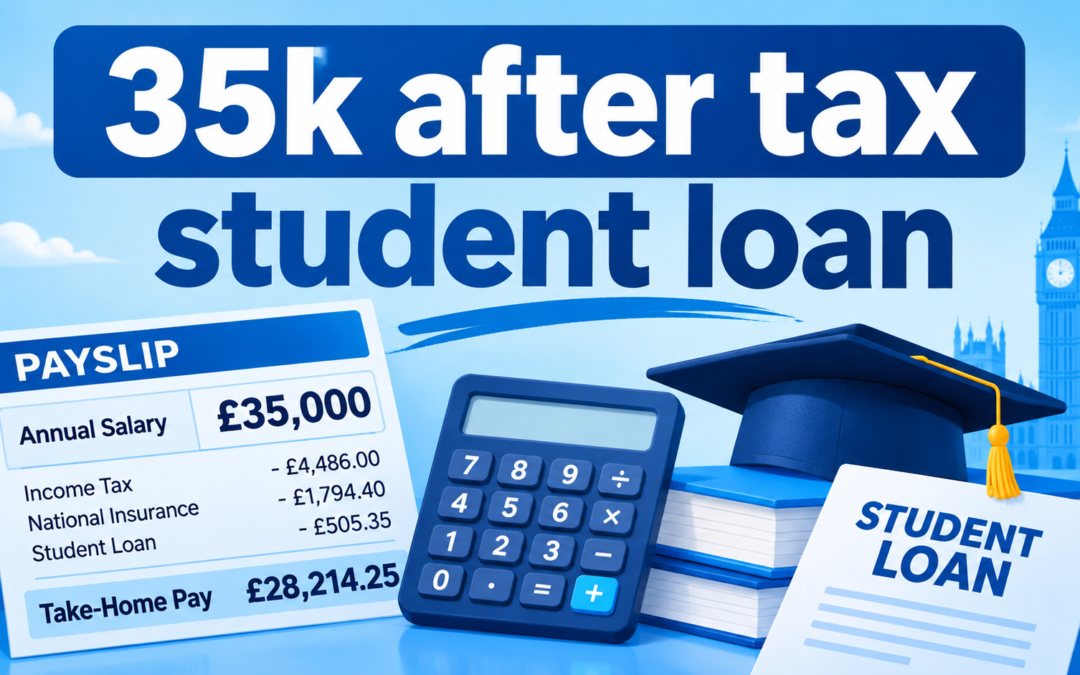
On 35k after tax student loan, your 2026/27 take-home is £28,214.25 on Plan 2 (an average of £2,351.19 a month), £27,990.60 on Plan 1, £27,819.60 on Plan 5 and £27,374.25 with Plan 2 plus a Postgraduate Loan. These figures use tax code 1257L outside Scotland. Without a loan you would keep £28,719.60.
Most salary calculators tell you what you repay. They rarely show what lands in your bank account once the loan is taken. This guide to 35k after tax and student loan deductions puts the take-home figure first, for every plan, and then explains why the numbers look the way they do. Not sure which plan you have? Check our sister guide, what student loan plan am I on?, first.
It also covers two loans at once, pay rises, salary sacrifice and self-employment, using 2026/27 rates.
- Plan 2 borrowers on £35,000 repay £505.35 a year and take home £28,214.25.
- Plan 5 has the lowest threshold of the undergraduate plans, so it takes the most: £900 a year.
- A Postgraduate Loan is repaid on top, at 6% over £21,000.
- For a basic-rate taxpayer outside Scotland with an undergraduate loan, 37p of each extra £1 above the thresholds can go on tax, National Insurance and the loan.
- Salary sacrifice reduces your repayments; a net pay pension does not.
35k after tax student loan: Take-Home by Plan
Start with the figures without a loan. On £35,000 you pay £4,486 Income Tax and £1,794.40 National Insurance, which leaves £28,719.60 a year, or £2,393.30 a month (GOV.UK Income Tax rates; National Insurance rates). The student loan then comes off that figure.
The table below shows how each repayment is worked out on £35,000 and what is left each year, with the monthly average alongside.
| Your loan | How the repayment is worked out | Repayment a year | Take-home a year | Monthly average |
|---|---|---|---|---|
| No student loan | No deduction | £0.00 | £28,719.60 | £2,393.30 |
| Plan 1 | 9% × (£35,000 − £26,900) | £729.00 | £27,990.60 | £2,332.55 |
| Plan 2 | 9% × (£35,000 − £29,385) | £505.35 | £28,214.25 | £2,351.19 |
| Plan 5 | 9% × (£35,000 − £25,000) | £900.00 | £27,819.60 | £2,318.30 |
| Postgraduate Loan only | 6% × (£35,000 − £21,000) | £840.00 | £27,879.60 | £2,323.30 |
| Plan 2 + Postgraduate Loan | £505.35 (Plan 2) + £840.00 (PG) | £1,345.35 | £27,374.25 | £2,281.19 |
| Plan 5 + Postgraduate Loan | £900.00 (Plan 5) + £840.00 (PG) | £1,740.00 | £26,979.60 | £2,248.30 |
| Plan 4, Scottish taxpayer | 9% × (£35,000 − £33,795) | £108.45 | £28,596.08 | £2,383.01 |
The figures assume tax code 1257L, no pension deductions and no other income. Monthly figures are annual amounts divided by 12, not payslip amounts. To try other salaries, use Eternity’s UK salary calculator.
How Your Student Loan Repayment on £35k Is Worked Out
Student loan repayments are a percentage of what you earn above your plan’s threshold. Undergraduate plans take 9% and the Postgraduate Loan takes 6% (GOV.UK: Repaying your student loan).
| Plan | Yearly threshold | Monthly threshold | Rate |
|---|---|---|---|
| Plan 1 | £26,900 | £2,241 | 9% |
| Plan 2 | £29,385 | £2,448 | 9% |
| Plan 4 | £33,795 | £2,816 | 9% |
| Plan 5 | £25,000 | £2,083 | 9% |
| Postgraduate Loan | £21,000 | £1,750 | 6% |
On Plan 2, for example, you earn £5,615 above the £29,385 threshold. Nine per cent of that is £505.35 a year. The repayment depends only on your income, not on how much you borrowed.
Your employer works it out each payday using the monthly or weekly threshold. For employees, deductions are generally calculated on the earnings used for Class 1 National Insurance, rather than on take-home pay after Income Tax. Certain payments and salary sacrifice arrangements can affect the calculation, so see HMRC’s special rules for student loans where needed.
Your 35k After Tax and Student Loan Figures, Plan by Plan
Plan 1
Plan 1 covers courses in England or Wales that started before September 2012, and most Northern Ireland loans. You repay 9% of £8,100 above the £26,900 threshold: £729 a year.
Plan 2
Plan 2 covers courses in England or Wales that started between September 2012 and July 2023. Its £29,385 threshold is the highest in England and Wales, so the repayment is a modest £505.35.
Plan 4 and Scottish Income Tax
Plan 4 is for Scottish loans and has the highest threshold, £33,795. You repay only £108.45 a year on £35,000. Scottish taxpayers also pay slightly more Income Tax at this salary: £4,501.07 rather than £4,486, using the 2026/27 Scottish bands.
A Scottish taxpayer earning £35,000 with a Plan 4 loan takes home £28,596.08 under these assumptions. This figure uses Scottish Income Tax rates as well as the Plan 4 repayment threshold. Do not compare it directly with the England and Wales figures without accounting for the different Income Tax bands.
Plan 5
Plan 5 applies to undergraduate courses (and some other courses, such as PGCEs) in England that started from 1 August 2023, and repayments began in April 2026. Its threshold is £25,000, the lowest undergraduate threshold, so on £35,000 you repay 9% of £10,000. That is £900 a year, or £75 a month, leaving you with £27,819.60.
Postgraduate Loan
A Postgraduate Loan for a master’s or doctoral course is repaid at 6% of income over £21,000. On £35,000, that is £840 a year or £70 a month. Many people repay one alongside an undergraduate loan.
Repaying Two Student Loans at Once
Two loans do not always mean two repayments, as the table shows.
| Your loans | How you repay on £35,000 | Total a year | Take-home |
|---|---|---|---|
| Plan 2 + Postgraduate Loan | 9% over £29,385 plus 6% over £21,000 | £1,345.35 | £27,374.25 |
| Plan 5 + Postgraduate Loan | 9% over £25,000 plus 6% over £21,000 | £1,740.00 | £26,979.60 |
| Plan 1 + Plan 2 | 9% over the lower threshold (£26,900) only | £729.00 | £27,990.60 |
| Postgraduate Loan only (for comparison) | 6% over £21,000 | £840.00 | £27,879.60 |
An undergraduate loan and a Postgraduate Loan are repaid at the same time, so both deductions appear on your payslip (GOV.UK).
If you have both Plan 1 and Plan 2 loans, you do not normally pay two separate 9% deductions. The repayment is generally calculated at 9% above the lower applicable threshold. Special repayment allocation and monthly repayment cap rules can apply, so the amount allocated to each loan may differ from a simple annual calculation. Check HMRC’s employer guidance for the detailed rules.
Weekly and Hourly Take-Home With a Student Loan
If you are paid weekly or want an hourly figure, the table below converts the yearly take-home. Weekly figures are the annual amount divided by 52; hourly figures assume a 37.5-hour week, with no paid overtime.
| Your loan | Take-home a week | Take-home an hour |
|---|---|---|
| No student loan | £552.30 | £14.73 |
| Plan 1 | £538.28 | £14.35 |
| Plan 2 | £542.58 | £14.47 |
| Plan 4, Scottish taxpayer | £549.92 | £14.66 |
| Plan 5 | £534.99 | £14.27 |
| Postgraduate Loan only | £536.15 | £14.30 |
| Plan 2 + Postgraduate Loan | £526.43 | £14.04 |
| Plan 5 + Postgraduate Loan | £518.84 | £13.84 |
Weekly payroll uses the weekly thresholds instead, such as £565 for Plan 2, so a weekly payslip can differ slightly from these averages. Over a full year, the totals should come out very close.
Why a Pay Rise Feels Smaller With a 35k Salary and Student Loan
Your deductions depend on your student loan plan and whether you also repay a Postgraduate Loan. For a basic-rate taxpayer in England, Wales or Northern Ireland, an undergraduate loan can take 37p from each additional £1 above the relevant thresholds when Income Tax, National Insurance and student loan repayments all apply. A Postgraduate Loan adds a further deduction, while Scottish Income Tax rates can produce a different result.
How much do you keep from an extra £1?
The table shows what happens to each extra pound, and to a £1,000 pay rise, for someone already earning £35,000.
| Your situation | Income Tax | NI | Loan | You keep from £1 | You keep from a £1,000 rise |
|---|---|---|---|---|---|
| Undergraduate plan (1, 2 or 5) | 20p | 8p | 9p | 63p | £630 |
| Postgraduate Loan only | 20p | 8p | 6p | 66p | £660 |
| Undergraduate plan + Postgraduate Loan | 20p | 8p | 15p | 57p | £570 |
| Plan 4, Scottish taxpayer (21% band) | 21p | 8p | 9p | 62p | £620 |
| Gross salary | Plan 1 | Plan 2 | Plan 5 |
|---|---|---|---|
| £30,000 | £24,840.60 | £25,064.25 | £24,669.60 |
| £32,000 | £26,100.60 | £26,324.25 | £25,929.60 |
| £34,000 | £27,360.60 | £27,584.25 | £27,189.60 |
| £35,000 | £27,990.60 | £28,214.25 | £27,819.60 |
| £36,000 | £28,620.60 | £28,844.25 | £28,449.60 |
| £38,000 | £29,880.60 | £30,104.25 | £29,709.60 |
| £40,000 | £31,140.60 | £31,364.25 | £30,969.60 |
Each step of £2,000 adds £1,260 to take-home on every plan, because all three thresholds are below £30,000.
Can a Pension Reduce Your Student Loan Repayments?
It can, depending on how your workplace pension is taken. Student loan deductions are based on the same pay used for National Insurance (LITRG), so what matters is whether your pension reduces that figure.
| Pension method | Does it reduce your loan repayment? | Why |
|---|---|---|
| Salary sacrifice | Yes | Your salary is lower, so National Insurance pay is lower |
| Net pay arrangement | No | It reduces taxable pay but not National Insurance pay |
| Relief at source | No | You pay in from take-home pay; your gross pay is unchanged |
Sam earns £35,000 and pays 5% (£1,750) into a pension. Through salary sacrifice, his loan is worked out on £33,250, so he repays £347.85 rather than £505.35, saving £157.50 a year. His take-home is £27,111.75. Through a net pay arrangement, the loan is still worked out on £35,000, and his take-home is £26,814.25.
A genuine contractual salary sacrifice arrangement can reduce the earnings used to calculate student loan deductions. This is different from an ordinary pension contribution made through a net pay or relief-at-source arrangement. However, salary sacrifice must comply with National Minimum Wage requirements and can affect other salary-related benefits. Check the full implications first; Eternity’s guide to salary sacrifice pensions explains the trade-offs.
Payslip Rounding, Wrong Plans and Refunds
Your payslip deduction will not always match the yearly figure divided by 12. Employers work out each deduction against the monthly threshold, and student loan deductions are recorded in whole pounds, so pence are dropped (GOV.UK).
| Plan | Monthly payslip deduction on £35,000 | Over 12 months | Yearly calculation |
|---|---|---|---|
| Plan 1 | £60 | £720 | £729.00 |
| Plan 2 | £42 | £504 | £505.35 |
| Plan 4 | £9 | £108 | £108.45 |
| Plan 5 | £75 | £900 | £900.00 |
| Postgraduate Loan | £69 | £828 | £840.00 |
The monthly figures in this guide are annualised averages, not guaranteed monthly payroll deductions. Employers calculate student loan repayments separately for each pay period using the relevant payroll threshold and rounding rules. Bonuses, overtime, weekly pay and irregular earnings can therefore produce different deductions from the annual average.
Because deductions are worked out each payday, uneven pay can push them up. A bonus month or overtime can trigger a deduction even if your income for the whole year is below the threshold. You may then be owed a refund from the Student Loans Company.
Check the plan on your payslip too. If your employer is using the wrong plan, download your Active Plan Type letter from your student loan account and give it to payroll. Our guide to student loan refunds explains how to reclaim an overpayment.
Self-Employed on £35k? Student Loans Through Self Assessment
If you are self-employed, no employer takes the loan from your pay. Instead, HMRC works out the repayment on your Self Assessment tax return, based on your total income for the year (LITRG).
On £35,000 of profit with a Plan 2 loan, you would pay £4,486 Income Tax, £1,345.80 Class 4 National Insurance and £505.35 student loan, keeping £28,662.85. The repayment is due by 31 January after the tax year ends.
This example assumes £35,000 of taxable trading profit, the standard Personal Allowance, no other taxable income, no pension contributions and no additional adjustments. It is an illustrative calculation rather than a guaranteed Self Assessment bill. Your actual liability may differ depending on your circumstances and the applicable National Insurance rules. See GOV.UK: Self Assessment tax returns.
- Student loan repayments are not included in payments on account, so the whole amount falls due on 31 January.
- Certain unearned income, including relevant rental income and savings interest, can affect your student loan repayment through Self Assessment. Where the £2,000 threshold is exceeded, the full relevant amount may be counted, not just the excess. Check HMRC’s current Self Assessment rules for what to include.
- If you are employed and have other income, HMRC deducts what your employer already took and asks you to pay any balance.
- Making Tax Digital for Income Tax changes how you keep records and report, but the loan is still calculated on your final figures for the year.
If you need help with your return, MTDFix handles Self Assessment for sole traders and landlords. Our fixed-fee prices are published online.
What Changes for Student Loans in April 2027
Two changes for 2027/28 have been announced. First, the Plan 1 threshold rises to £28,005 for 6 April 2027 to 5 April 2028 (CIPP, 10 August 2026). On £35,000, the Plan 1 repayment falls from £729 to £629.55 (9% × £6,995), saving £99.45 a year.
Second, the Plan 2 threshold is frozen at £29,385 from April 2027 to April 2030, following the November 2025 Budget (CIPP). If your salary rises in that time, more of it will sit above the threshold, so your repayments will go up.
At 14 November 2026, the 2027/28 thresholds for Plan 4, Plan 5 and the Postgraduate Loan had not been published. The figures in this guide use the 2026/27 thresholds: £33,795, £25,000 and £21,000. Check GOV.UK before April 2027.
35k After Tax and Student Loan: FAQs
How much is 35k after tax with a Plan 2 student loan?
In 2026/27, £35,000 with a Plan 2 loan leaves you with £28,214.25 a year, or about £2,351 a month, on tax code 1257L outside Scotland. The loan takes £505.35 a year.
What is 35k after tax on Plan 5?
With a Plan 5 loan, £35,000 leaves you with £27,819.60 a year, or about £2,318 a month. Plan 5 has a £25,000 threshold, so the repayment is £900 a year.
How much student loan do I repay on £35,000?
It depends on your plan: £729 on Plan 1, £505.35 on Plan 2, £108.45 on Plan 4, £900 on Plan 5 and £840 on a Postgraduate Loan, each a year in 2026/27.
Do I repay my undergraduate loan and Postgraduate Loan at the same time?
Yes. Both are deducted together. On £35,000, Plan 2 plus a Postgraduate Loan costs £1,345.35 a year, leaving take-home pay of £27,374.25.
Does salary sacrifice reduce student loan repayments?
Yes. Deductions are based on the pay used for National Insurance, and salary sacrifice lowers that pay. A net pay pension arrangement does not reduce your repayments.
Why is my payslip deduction different from the yearly figure?
Employers work out deductions each payday against the monthly or weekly threshold and record them in whole pounds. So your monthly deduction can be slightly lower or higher than the yearly figure divided by 12.
Is my student loan included in my tax code?
No. Your tax code covers Income Tax only. Student loan deductions are worked out separately by your employer, based on the plan HMRC tells them to use.
Do self-employed people repay student loans on £35k profit?
Yes, through Self Assessment. On £35,000 of profit with a Plan 2 loan, the repayment is £505.35, due by 31 January and not included in payments on account.
What is £35,000 after tax with a Postgraduate Loan only?
With only a Postgraduate Loan, you repay 6% of £14,000, which is £840 a year. Your take-home is £27,879.60, an average of £2,323.30 a month, on tax code 1257L outside Scotland.
Does having two undergraduate loans mean I pay 18%?
No. Having two undergraduate student loans does not normally mean paying two separate 9% deductions. Repayments are generally calculated using one 9% deduction above the relevant lower threshold, subject to the applicable rules. A separate Postgraduate Loan can add another 6% deduction above its own threshold.
Does overtime increase student loan deductions?
It can. Deductions are worked out for each pay period, so a month with overtime or a bonus can take you further over the monthly threshold and produce a bigger deduction. If your income for the whole year ends up below the threshold, you may be able to claim a refund.
Can I stop student loan deductions when my loan is nearly paid off?
Payroll deductions continue until the Student Loans Company tells HMRC to stop them. If you are close to clearing your loan, you can ask the Student Loans Company about switching to Direct Debit to avoid overpaying; check the options on GOV.UK. Any overpayment is refunded.
Does student loan repayment affect my credit score?
Income-contingent student loans from the Student Loans Company are generally not reported to credit reference agencies in the same way as ordinary borrowing. However, lenders, including mortgage lenders, may take your monthly repayments into account when assessing affordability.
Can I get a refund if too much was taken?
Possibly. If your income for the whole year was below your threshold, or your employer used the wrong plan, you can ask the Student Loans Company for a refund after the tax year ends.
Final Verdict on 35k After Tax and Student Loan
On £35,000, a student loan costs between £108 and £1,740 a year, depending on your plan, so your take-home ranges from £26,979.60 to £28,596.08. Know your plan, check your payslip, consider salary sacrifice if your employer offers it, and remember that a pay rise is worth less once you are over your threshold.
MTDFix files Self Assessment returns so student loan repayments are worked out correctly.
✓ Student loan worked out on total income
✓ MTD for Income Tax ready
We calculated each example using the published 2026/27 Income Tax rates, National Insurance thresholds and student loan repayment thresholds. Annual take-home pay is shown after the stated deductions and assumes the standard tax code, no pension contributions and no additional income unless otherwise stated. Monthly figures are annual amounts divided by 12 and may differ from actual payroll deductions.
Written by Marina Jahan using GOV.UK and gov.scot rates and thresholds for 2026/27, HMRC employer guidance and LITRG. Every take-home figure was calculated in code and assumes tax code 1257L, no pension unless stated and no other income. Names in examples are invented. This is general information, not personal advice.