
By Shamayun Chowdhury, Senior Accountant, Major Accountancy · Published: 7 November 2026 · Last reviewed: November 2026 · Standard rate goods (20% VAT)
If you buy used items from the public and sell them on, standard VAT can wipe out your profit. You paid no VAT when you bought the item, yet you would owe VAT on the whole selling price. The VAT margin scheme fixes that by charging VAT only on the difference between what you paid and what you sold for.
This guide explains who can use it, how the calculation works with real numbers, when it is worth using, what records and invoices you need, and exactly what goes in each box of your VAT return. It also covers the global accounting and auctioneers’ versions of the scheme.
- VAT under the margin scheme is one-sixth of your margin on standard rate goods, not 20% of the selling price.
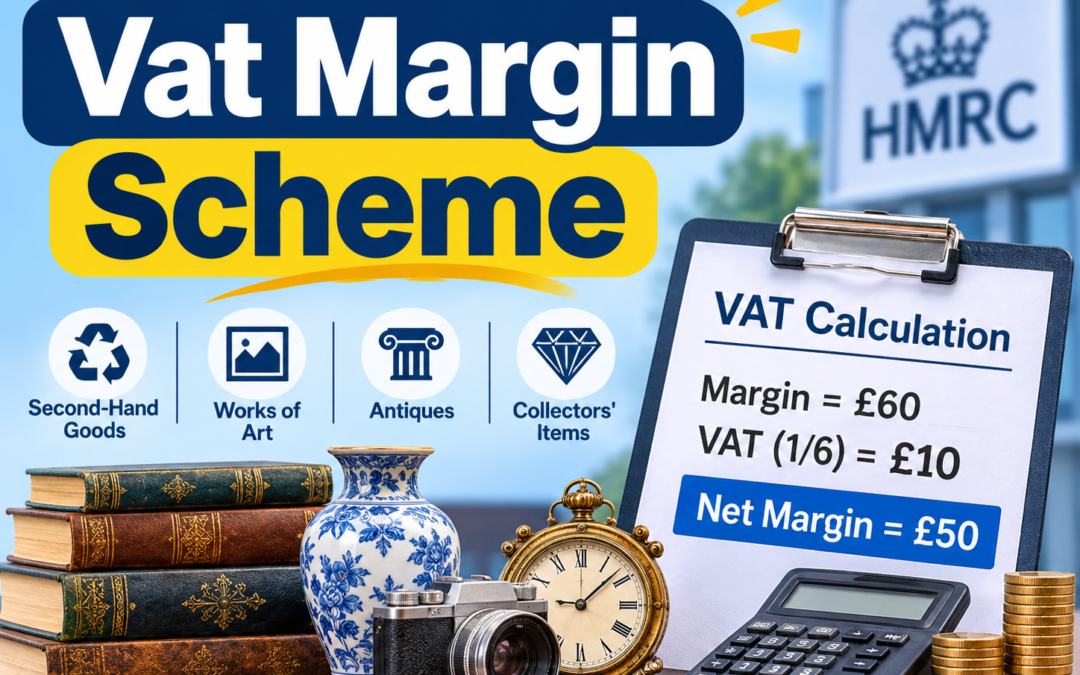
- It applies to second-hand goods, works of art, antiques and collectors’ items.
- You cannot use it for goods bought with VAT shown separately, precious metals, investment gold or precious stones.
- There is no application form. You use it by keeping the right records and reporting it on your VAT return.
- Repairs and parts are not added to the margin, but you can usually reclaim their VAT in the normal way.
What Is the VAT Margin Scheme?
The VAT margin scheme is an optional way of accounting for VAT on certain goods that have usually already been through someone else’s hands. HMRC’s main guide to VAT margin schemes and the detailed rules in the Notice 718 collection set out how it works.
Which goods are eligible
- Second-hand goods: items that can be used again as they are, or after repair, such as furniture, phones, clothing, tools and vehicles.
- Works of art: paintings, drawings, sculptures and similar original works, with some exclusions such as technical drawings and hand-decorated manufactured items.
- Antiques: goods more than 100 years old.
- Collectors’ items: for example stamps, coins and certain items of scientific, historical or archaeological interest.
When you cannot use it
- you bought the item on an invoice showing VAT separately
- the item is a precious metal, investment gold or a precious stone
- you cannot meet the record-keeping and invoice rules, in which case VAT is due on the full selling price
No separate application
There is no form to fill in to join. If you are VAT registered, you start using the margin scheme by keeping the records it requires and reporting the sales correctly on your VAT return. If you are not yet registered, the normal VAT registration rules still apply, including the £90,000 taxable turnover threshold.
How Does the VAT Margin Scheme Work?
For each eligible item, you work out your margin and then the VAT inside it:
- Margin = selling price minus purchase price
- VAT due = margin × 1/6 (for goods taxed at the 20% standard rate)
The one-sixth fraction is used because the selling price already includes VAT. For example, if the margin is £60, the VAT inside it is £10 and your net margin is £50.
Only the price you paid for the item counts as the purchase price. Repairs, spare parts, cleaning, transport and other overheads cannot be added. Instead, if those costs carry VAT, you can usually reclaim it on your VAT return in the normal way.
Who Uses the VAT Margin Scheme?
The scheme suits any VAT-registered business whose stock mostly comes from people who did not charge VAT. Typical users include:
| Business | Typical stock | Why the scheme helps |
|---|---|---|
| Phone and laptop refurbishers | Used devices bought from the public | Buying prices carry no VAT, so standard VAT would hit the full sale |
| Antiques and vintage dealers | Furniture, clocks, jewellery over 100 years old | Margins can be modest compared with the selling price |
| Online resellers | Clothes, trainers, collectables bought privately | High volume of small, VAT-free purchases |
| House clearance firms | Mixed bulk lots | Global accounting avoids tracking every item |
| Art galleries and dealers | Paintings and sculptures | Special margin rules for works of art |
| Used car dealers | Cars bought from private sellers | Car margins can be small compared with the price |
If most of your stock is bought new from VAT-registered suppliers, the scheme is unlikely to help, because you can already reclaim the VAT on those purchases.
VAT Margin Scheme Calculation: Worked Examples
These worked examples show the VAT margin scheme calculation in practice. All figures are our own illustrations, calculated for standard rate goods.
Example 1: a painting
An art dealer buys a painting for £1,500 and sells it for £2,000. The margin is £500, so the VAT due is £500 × 1/6 = £83.33. This is the same example GOV.UK uses.
Example 2: a refurbished phone
A refurbisher buys a used phone from a member of the public for £200, spends £40 plus £8 VAT on a new screen, and sells the phone for £360.
| Item | Amount |
|---|---|
| Selling price | £360.00 |
| Purchase price | £200.00 |
| Margin | £160.00 |
| VAT due on the margin (£160 ÷ 6) | £26.67 |
| VAT reclaimable on the screen repair | £8.00 |
The £40 repair is not added to the purchase price, but the £8 VAT on it can usually be reclaimed separately.
Example 3: selling at a loss
If the refurbisher buys a laptop for £400 and can only sell it for £350, there is no margin, so no VAT is due on that sale. Under the standard item-by-item scheme, that £50 loss cannot be used to reduce the VAT due on other items. Global accounting, covered below, works differently.
Margin Scheme vs Standard VAT: Is It Worth It?
Using Example 2, here is the same phone sold both ways:
| Margin scheme | Standard VAT | |
|---|---|---|
| Selling price (VAT inclusive) | £360.00 | £360.00 |
| VAT due on the sale | £26.67 | £60.00 |
| Amount you keep before other costs | £333.33 | £300.00 |
| Difference | £33.33 more kept | — |
For goods bought from the public without VAT, the margin scheme is usually the better choice. Standard VAT can be better where:
- you bought the item with VAT shown on the invoice, so you can reclaim that input VAT
- your buyers are VAT-registered businesses who want a VAT invoice to reclaim VAT
- the margin is so large that the record keeping is not worth the small saving
Choosing item by item
You do not have to put your whole business on the margin scheme. The choice is made item by item: you can use the scheme for a phone bought from a private seller and standard VAT for a phone bought new from a wholesaler.
What matters is that your records show clearly which route each sale took, and that the invoice matches it. Once a sale has been invoiced under normal VAT rules, do not try to switch it into the scheme later.
Buyers cannot reclaim VAT on a margin scheme invoice, because VAT is not shown on it. If you sell mainly to VAT-registered businesses, check whether they need a standard VAT invoice before you choose the margin scheme for an item.
VAT Margin Scheme Stockbook and Records
The margin scheme depends on records that track every item from purchase to sale. Alongside your normal VAT records, you need a stockbook and copies of all purchase and sales invoices.
| Purchase details | Sales details |
|---|---|
| Stock number | Sale date |
| Purchase date | Selling price, or how the item was disposed of |
| Purchase price | Buyer’s name |
| Seller’s name | Sales invoice number |
| Description of the item | Margin on the item |
| Purchase invoice number (unless you wrote the invoice) | VAT due on the margin |
Keep these records for 6 years. For stock you bought more than 6 years ago, keep the records until the item is sold.
If you are VAT registered, you must also follow Making Tax Digital for VAT, which means keeping digital records and filing through compatible software. A spreadsheet stockbook linked to MTD bridging software, or accounting software with a margin scheme feature, both work. Our guide to MTD for VAT explains the digital record rules.
Before you sell your first item under the scheme
- Confirm the item is eligible and was not bought with VAT shown.
- Give it a stock number and enter it in your stockbook on the day you buy it.
- Keep proof of the purchase price, such as a receipt, bank transfer or self-written invoice.
- Set up your invoice template with the correct scheme wording.
- Check your software can report margin scheme sales in Boxes 1, 6 and 7.
Margin Scheme Invoice Wording
A sales invoice under the scheme must show the date, your name, address and VAT number, the buyer’s details, the stock number, the invoice number, a description of the item and the total price. It must not show VAT separately. It must also include one of these exact phrases:
- “margin scheme – second hand goods”
- “margin scheme – works of art”
- “margin scheme – collectors’ items and antiques”
When you buy from someone who is not VAT registered, you often write the purchase invoice yourself, showing the date, both parties’ details, a description and the total price. If the seller is VAT registered and also uses the margin scheme, their invoice should include the stock number and the scheme wording.
Filling In Your VAT Return
Margin scheme sales still go on your VAT return, but the boxes work slightly differently. Using Example 2:
| Box | What goes in it | Example 2 |
|---|---|---|
| Box 1 | VAT due on the margin | £26.67 |
| Box 6 | Full selling price, less the VAT due on the margin | £333.33 |
| Box 7 | Full purchase price of eligible goods bought | £200.00 |
| Boxes 8 and 9 | Margin scheme purchases and sales are not included | — |
The £8 VAT on the repair is reclaimed in Box 4 in the usual way. For return deadlines and payment timings, see our guide to VAT payment dates.
Global Accounting and the Auctioneers’ Scheme
Global accounting scheme
The global accounting scheme is a simpler version for businesses that buy and sell low-value goods in bulk, such as house clearance firms or market traders. Instead of working out the margin item by item, you work it out for the whole VAT period.
- Each item must be bought for less than £500. A bulk lot can qualify even if the total is over £500, if the individual items are low value.
- It cannot be used for aircraft, boats and outboard motors, caravans and motor caravans, horses and ponies, or motor vehicles including motorcycles, as set out in HMRC’s manual at VATMARG03100.
- VAT is the total sales minus total purchases for the period, multiplied by 1/6 for standard rate goods.
- If purchases are higher than sales, no VAT is due, and the negative margin is carried forward to the next period.
For example, if a house clearance business sells £8,000 of eligible goods in a quarter and buys £5,600, the global margin is £2,400 and the VAT due is £400.
If the next quarter had sales of £3,000 and purchases of £4,200, the margin would be minus £1,200. No VAT would be due, and the £1,200 would reduce the margin in the following quarter. When you leave the scheme, you may need to account for VAT on unsold stock.
Auctioneers’ scheme
Auctioneers selling eligible goods in their own name can use a separate auctioneers’ scheme. The margin is broadly the hammer price plus the buyer’s charges, minus the hammer price less the seller’s commission. VAT is not shown separately on scheme charges.
Second-hand cars, Northern Ireland and travel
Second-hand cars can be sold under the margin scheme, but they cannot use global accounting. If you buy or sell goods between Northern Ireland and the EU, there are extra rules. Tour operators use a different scheme, the Tour Operators’ Margin Scheme.
Common Mistakes With the VAT Margin Scheme
| Mistake | What happens | Better approach |
|---|---|---|
| Showing VAT on the sales invoice | The sale may not qualify for the scheme | Never show VAT separately |
| Adding repairs to the purchase price | Margin and VAT understated | Reclaim repair VAT separately |
| Using it for items bought with VAT | VAT due on the full price | Use standard VAT for those items |
| No stockbook or missing invoices | HMRC can charge VAT on full selling prices | Keep a record for every item |
| Offsetting losses item by item | VAT underpaid | Only global accounting carries losses forward |
How MTDFix Can Help
MTDFix prepares MTD-compatible VAT returns for resellers, dealers and refurbishers, including margin scheme sales, so your Box 1, 6 and 7 figures are right first time and your digital records stand up to an HMRC check.
VAT Margin Scheme FAQs
Do I need to register for the margin scheme?
No. There is no separate application. If you are VAT registered, you can start using it by keeping the required records and reporting correctly on your VAT return.
Can I use the margin scheme if I am not VAT registered?
If you are not VAT registered, you do not charge VAT at all, so the scheme is not needed. Once your taxable turnover goes over £90,000, you must register, and the scheme can then reduce the VAT on eligible sales.
Can I reclaim VAT on repairs?
Usually yes. Repairs and parts are not added to the margin, but VAT on them can normally be reclaimed on your VAT return in the usual way.
What if I sell an item at a loss?
No VAT is due on that item. Under the standard scheme, the loss cannot reduce the VAT on other items. Under global accounting, a negative margin is carried forward to the next period.
Can I use it for items I bought on eBay or Facebook Marketplace?
Often yes, if you bought them from private sellers with no VAT charged and they are eligible goods. Keep the advert, payment proof and a self-written purchase invoice for each item.
Does the buyer see VAT on a margin scheme invoice?
No. VAT must not be shown separately, which is why VAT-registered buyers cannot reclaim VAT on margin scheme purchases.
Can I mix margin scheme and standard VAT sales?
Yes. You can use the margin scheme for eligible items and standard VAT for everything else, as long as your records keep them separate.
Final Word on the VAT Margin Scheme
The VAT margin scheme can make the difference between a profitable reselling business and one that hands most of its margin to HMRC. Check each item is eligible, keep a stockbook from day one, use the exact invoice wording, and put the right figures in Boxes 1, 6 and 7. If your stock is mostly low-value and bought in bulk, look at global accounting too.
MTDFix files VAT returns for sole traders and limited companies using HMRC-recognised MTD software.
Written by Shamayun Chowdhury, with every rule checked against GOV.UK and HMRC’s VAT Margin Schemes Manual in November 2026. The worked examples are our own calculations. No separate technical reviewer is named. This guide is general information, not advice for your circumstances.