
By Marina Jahan · Published: 17 November 2026 · Last reviewed: November 2026 · Rules for 2026/27
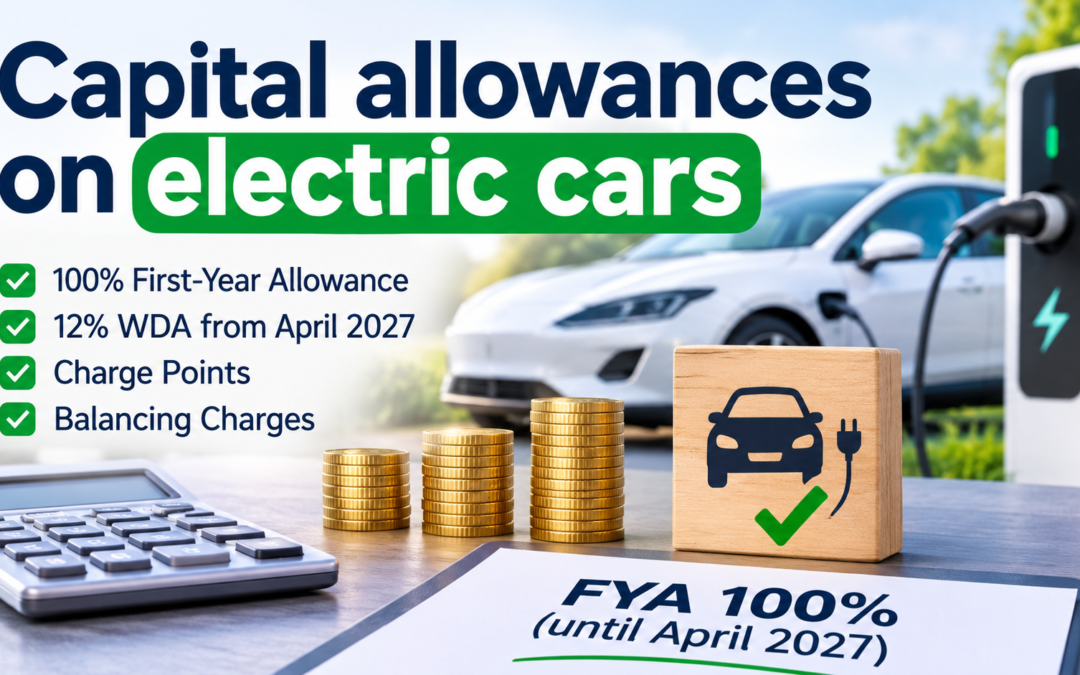
Timing has never mattered more for capital allowances on electric cars. A limited company that takes delivery of a £40,000 electric car on 15 March 2027 can deduct the full £40,000 from that year’s profits. If the same car arrives three weeks later, the first-year deduction can drop to £4,800. At a 25% Corporation Tax rate, that is the difference between £10,000 and £1,200 of tax relief in year one.
This guide covers the deadline for your business, when HMRC treats the money as spent, what you really save, selling, leasing, charge points and VAT. For all other cars, including petrol and plug-in hybrids, see Eternity Accountants’ guide to capital allowances on cars.
- Only new and unused cars with zero CO2 emissions qualify for the 100% first-year allowance.
- Companies must incur the spending by 31 March 2027; sole traders and partnerships by 5 April 2027.
- Spending usually counts on the date the car is delivered, not the date you order it.
- If you sell a car you claimed 100% on, the sale price is usually taxed as a balancing charge.
- Second-hand electric cars get the main rate (14%, falling to 12% from April 2027), and leased cars get no capital allowances at all.
Capital Allowances on Electric Cars: How the 100% Allowance Works
Capital allowances let a business deduct the cost of equipment from its taxable profits. For most cars, that deduction is spread over many years, but a new zero-emission car can be claimed in full as a first-year allowance (FYA) in the period you buy it. It reduces profits; it is not a tax credit.
To qualify, the car must have zero CO2 emissions and be new and unused (GOV.UK: first-year allowances). Fully electric and hydrogen cars meet the test. Plug-in hybrids do not, however low their emissions. You also cannot claim the 100% allowance on a car your business buys to lease to someone else.
Cars sit outside the Annual Investment Allowance, full expensing and the main rate first-year allowance. That allowance started at 40% on 1 January 2026 and rises to 50% for spending from 1 January 2027, but cars and second-hand assets are still excluded (HMRC policy paper). So the EV allowance is the only way to deduct a car’s full cost in one year. Eternity explains the wider picture in its guide to full expensing.
| Car bought by the business | Capital allowance | Pool |
|---|---|---|
| New, unused, zero emissions (before the deadline) | 100% first-year allowance | Main pool at nil value afterwards |
| Second-hand electric car | 14% a year, then 12% from April 2027 | Main pool |
| New electric car bought after the deadline | 12% a year (hybrid rate if your period straddles April 2027) | Main pool |
| Plug-in hybrid, 1 to 50g/km | 14% a year, then 12% from April 2027 | Main pool |
| Car over 50g/km | 6% a year | Special rate pool |
The main rate fell from 18% to 14% in April 2026. HMRC confirmed on 29 October 2026 that it will fall again, to 12%, for chargeable periods from 1 April 2027 (Corporation Tax) and 6 April 2027 (Income Tax). An accounting period that straddles the change gets a time-apportioned hybrid rate. The change is being legislated in Finance Bill 2026-27, and the special rate stays at 6% (HMRC policy paper).
The April 2027 Deadline: Which Date Applies to You?
The 100% allowance for zero-emission cars and electric charge points ends for spending on or after 1 April 2027 for Corporation Tax and 6 April 2027 for Income Tax (ICAEW). The government has not announced a further extension.
| Business type | Last day to incur the spending | Applies to |
|---|---|---|
| Limited company | 31 March 2027 | Zero-emission cars and charge points |
| Sole trader | 5 April 2027 | Zero-emission cars and charge points |
| Partnership or LLP with individual partners | 5 April 2027 | Zero-emission cars and charge points |
When does the spending count?
HMRC treats spending as incurred on the date the obligation to pay becomes unconditional (HMRC CA11800). When you buy goods, that is usually the day they are delivered, not the day you place the order or pay a deposit. A car ordered in February but delivered in May 2027 therefore misses the deadline.
Two further rules matter. If payment is not due until more than four months after delivery, the spending counts on the payment date instead. And if a contract is written so that payment becomes unconditional unusually early, mainly to bring the claim forward, HMRC can ignore that and use the normal date. Get a confirmed delivery date in writing.
What You Really Save: Before and After the Deadline
With capital allowances on electric cars, the 100% allowance does not give you more relief overall; it gives you the relief much sooner. Here is the same £40,000 electric car bought by a limited company that pays Corporation Tax at 25% and has a 31 March year end, delivered either side of the deadline. The figures are illustrative; if your accounting period straddles April 2027, the hybrid rate will change them slightly.
| Year | Delivered 15 March 2027 (100% FYA) | Delivered 2 April 2027 (12% a year) |
|---|---|---|
| Car price | £40,000 | £40,000 |
| Year 1 allowance | £40,000 | £4,800 |
| Year 2 allowance | £0 | £4,224 |
| Year 3 allowance | £0 | £3,717.12 |
| Total over 3 years | £40,000 | £12,741.12 |
| Tax relief over 3 years at 25% | £10,000 | £3,185.28 |
At the 19% small profits rate, the first-year saving on the earlier car would be £7,600. Buy early only if you would have kept the car anyway: an early sale brings much of the relief back as a balancing charge.
Electric Car Tax Relief for Sole Traders and Partnerships
Sole traders and partners can claim the same 100% allowance, but private use changes the numbers. A car that you also use personally goes into its own single asset pool, and the allowance is cut to your business-use percentage.
Priya is a self-employed consultant paying 40% Income Tax and 2% Class 4 National Insurance on her top slice of profit. In March 2027 she buys a new £35,000 electric car and uses it 80% for business. Her allowance is £35,000 × 80% = £28,000, worth about £11,760 in tax and National Insurance for 2026/27.
Keep a mileage log to support your business percentage. You also have to choose between capital allowances and simplified mileage for each car. If you claim the 100% allowance, you cannot also claim the flat mileage rate for that vehicle. Our guide to HMRC side hustle tax covers simplified expenses.
Limited Companies: Company Cars and Benefit in Kind
When a company buys the car, it claims the full allowance with no cut for private use. Instead, a director or employee who uses the car privately pays benefit in kind tax, and the company pays Class 1A National Insurance on that benefit.
| Tax year | BIK rate for a zero-emission car |
|---|---|
| 2025/26 | 3% |
| 2026/27 | 4% |
| 2027/28 | 5% |
| 2028/29 | 7% |
| 2029/30 | 9% |
For a £40,000 car in 2026/27, the taxable benefit is £1,600, which costs a higher-rate director £640. The advantage narrows each year. Eternity’s guide to electric company car tax covers BIK in detail.
Selling or Scrapping an EV: The Balancing Charge Trap
Some guides say the 100% allowance gives you full relief on the car. That is only true if you keep it until it is worth nothing. A car you claim 100% on still goes into your capital allowance pool, but at a value of nil. When you sell it, the proceeds come off the pool; if the pool goes below zero, the difference is taxed as a balancing charge.
1. A limited company’s main pool
A company car goes into the main pool, even if a director uses it privately. The sale proceeds reduce the whole pool, so a company with other main pool spending, such as vans or equipment, may simply see lower allowances in later years. A company with nothing else in the pool gets a balancing charge.
The company that bought a £40,000 EV in March 2027 has no other main pool spending. It sells the car three years later for £22,000, giving a balancing charge of £22,000, taxed at 25% (£5,500). Its overall relief is £40,000 − £22,000 = £18,000, which matches the real fall in the car’s value.
2. A sole trader’s single asset pool
A car with private use sits in its own pool, so there is no other spending to absorb the proceeds. The balancing charge is reduced by the same business-use percentage that limited the allowance. If Priya sells her car for £20,000, the taxable balancing charge is £20,000 × 80% = £16,000. If the proceeds were below the pool value, she would get a balancing allowance instead.
3. Scrapping, write-offs and insurance payouts
Scrapping or writing off the car is still a disposal. The amount you receive, whether scrap value or an insurance payout, is the disposal value. Plan sales for a year when other profits are lower, if you can.
Second-Hand, Leased and Hire Purchase EVs
The way you acquire the car decides which capital allowances on electric cars, if any, your business can claim.
| How you get the car | Capital allowances | Notes |
|---|---|---|
| Buy new for cash or with a loan | 100% FYA before the deadline | Must be new and unused |
| Buy second-hand | Main pool: 14%, then 12% from April 2027 | Even if it is only a few months old |
| Hire purchase | 100% FYA if new, before the deadline | Claim once the car is delivered and in use |
| Contract hire or lease | None for your business | Monthly rentals are a deductible expense instead |
| Salary sacrifice scheme | None for the employer | The leasing company owns the car |
Under hire purchase, your business is treated as the owner as soon as it is entitled to the car, and it can claim on the full price, including instalments not yet paid, once the car is in use (HMRC CA23310). With a lease, the lease company claims the allowances. Your rentals are deductible, and because an electric car is under 50g/km, there is no 15% restriction on them.
Charge Points and Other EV Costs
New and unused electric vehicle charge point equipment bought by your business also qualifies for the 100% allowance, with the same deadlines as cars (GOV.UK policy paper). It covers chargers and their installation, but not equipment for a home you let out.
Electricity you buy to charge a business car is a running cost, not a capital item. Public charging carries 20% VAT, which your business may be able to reclaim. Our guide to public EV charging VAT explains how.
Electric Car Charge Points: What Happens After April 2027?
The 100% charge point allowance ends at the same time as the car allowance: 31 March 2027 for companies and 5 April 2027 for sole traders and partnerships. Unlike a car, a charge point is ordinary plant, so it does not lose all special treatment afterwards. Depending on your business and the equipment, new charge points bought after the deadline may qualify for:
- the Annual Investment Allowance, which gives 100% relief up to the annual limit for most businesses;
- full expensing (100%) for companies buying new main rate plant;
- the 50% main rate first-year allowance for new main rate spending from 1 January 2027, which unincorporated businesses can also use;
- the 12% main rate writing down allowance on anything not covered above.
None of these is automatic. The equipment must be new where the allowance requires it, used in your business and not for a let home, and the right category of plant. Check eligibility before you rely on a particular rate (HMRC policy paper).
Can you claim VAT on an electric car?
Usually not. VAT on buying a car is blocked unless it is used exclusively for business and not available for private use (GOV.UK: VAT on cars). Where VAT is blocked, your capital allowance claim is on the VAT-inclusive price. If you lease instead, you can normally reclaim 50% of the VAT on the rentals.
Claiming It: Records, Tax Returns and MTD
To support capital allowances on electric cars, keep the paperwork that proves the car qualifies and when you bought it:
- the purchase invoice and finance agreement, showing the price and any VAT
- the delivery note or handover document, showing the date
- the V5C or manufacturer details confirming zero CO2 emissions
- a mileage log if you are a sole trader or partner using the car privately
Companies claim the allowance in their Corporation Tax return. Sole traders and partners claim it on their Self Assessment return. If you are within Making Tax Digital for Income Tax, record the purchase in your software, but capital allowances are normally finalised in the end-of-year submission rather than the quarterly updates.
Common Mistakes With EV Capital Allowances
| Mistake | What to do instead |
|---|---|
| Claiming 100% on a second-hand electric car | Claim the main rate (14%, then 12%) in the main pool |
| Counting the order date instead of delivery | Check when payment became unconditional, usually delivery |
| Claiming allowances on a leased car | Deduct the lease rentals instead |
| Treating a plug-in hybrid as zero-emission | Hybrids get the main rate (14%, then 12%) or 6%, never 100% |
| Forgetting the private-use cut as a sole trader | Multiply the allowance by your business-use percentage |
| Ignoring the balancing charge on sale | Plan the sale and expect the sale price to be taxed |
| Using 14% for periods after April 2027 | Use 12%, or a hybrid rate for a straddling period |
Capital Allowances on Electric Cars: FAQs
Do electric cars qualify for 100% capital allowances?
Yes, if the car is new, unused and has zero CO2 emissions, and your business incurs the cost before 1 April 2027 (companies) or 6 April 2027 (sole traders and partnerships).
When does the 100% first-year allowance for electric cars end?
It ends for spending on or after 1 April 2027 for Corporation Tax and on or after 6 April 2027 for Income Tax. After that, new electric cars get the main rate writing down allowance of 12%.
Can I claim 100% on a second-hand electric car?
No. The first-year allowance is only for new and unused cars. A second-hand electric car goes into the main pool at 14%, falling to 12% from April 2027.
Does a plug-in hybrid qualify for the first-year allowance?
No. Only cars with zero CO2 emissions qualify. A plug-in hybrid with emissions of 50g/km or less gets the main rate: 14%, falling to 12% from April 2027.
Can I buy an electric car through my limited company?
Yes. The company claims the 100% allowance if the car is new and bought before 1 April 2027, and you pay benefit in kind tax on private use.
Can I claim capital allowances on an electric car used privately?
Yes. A sole trader or partner claims only the business-use share, and the car goes into its own pool. A company claims in full, and the user pays benefit in kind.
If I order before April 2027 but take delivery after, can I still claim 100%?
Usually not. Spending normally counts when the car is delivered and payment becomes unconditional, not when you place the order or pay a deposit.
Is financing an electric car better than leasing?
Buying, including on hire purchase, can give the 100% allowance before the deadline. Leasing gives no allowance, but the rentals are deductible. The better option depends on cash flow and how long you keep the car.
What happens if I sell my electric car after claiming 100% FYA?
The sale price comes off your pool. If the pool goes below zero, the excess is taxed as a balancing charge, reduced by any private-use share for sole traders.
Are electric car charging costs tax deductible?
Yes, electricity used to charge a business car is a running cost. Sole traders deduct only the business share, and companies can usually deduct the full cost.
Do electric car charge points qualify for 100% allowances?
Yes, until the April 2027 deadlines. After that, a new charge point may qualify for the AIA, full expensing or the 50% first-year allowance instead.
What will electric cars get after April 2027?
Unless the rules change, new electric cars bought after the deadline will get the 12% main rate writing down allowance, the same as second-hand electric cars.
Final Verdict on Capital Allowances on Electric Cars
If your business was planning to buy a new electric car in 2027 anyway, getting it delivered before 31 March (companies) or 5 April (sole traders and partnerships) can bring forward thousands of pounds of tax relief. Make sure it is new, zero-emission and delivered in time, apply any private-use cut, and remember that selling it later brings some of the relief back.
MTDFix can check the timing of your EV purchase and claim the allowance correctly.
Written by Marina Jahan from GOV.UK’s capital allowances guidance, HMRC’s 29 October 2026 policy paper on the 12% writing down allowance and 50% first-year allowance (Finance Bill 2026-27), HMRC’s Capital Allowances Manual (CA11800 and CA23310) and ICAEW and ACCA news, as at 17 November 2026. Examples use invented names and were calculated in code. This is general information, not personal tax advice.
MTDFix is a trading name of Major Accountancy Ltd. Eternity Accountants, linked in this guide, is a sister accountancy firm.