
By Marina Jahan · Published: 12 November 2026 · Last reviewed: November 2026 · 2026/27 tax year
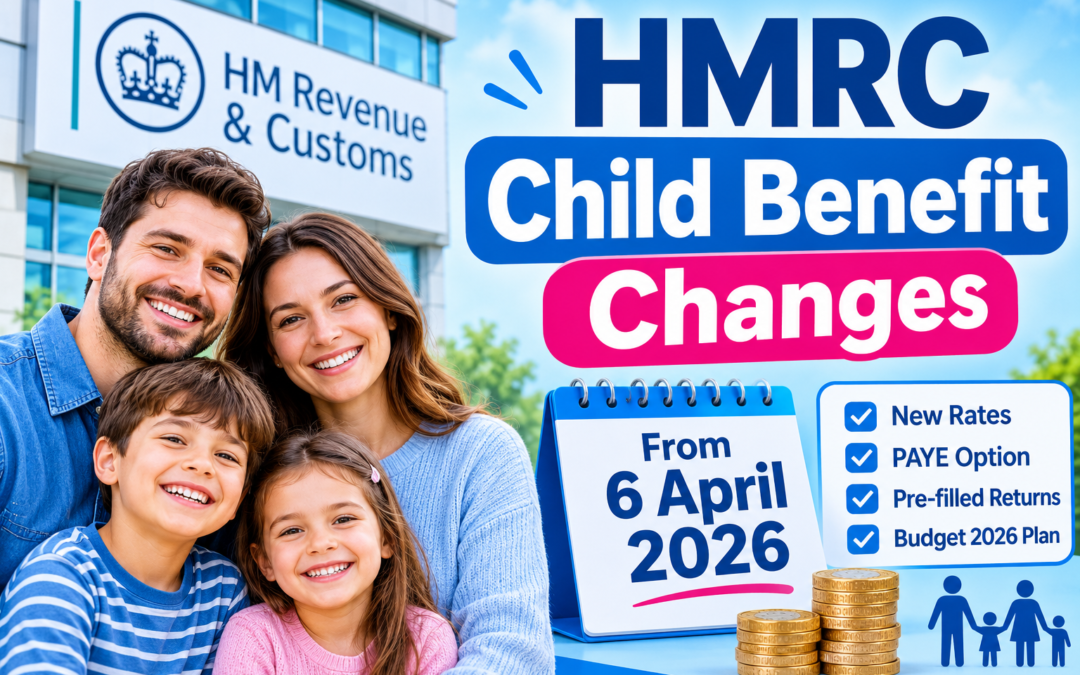
Four HMRC Child Benefit changes stand out in 2026/27: higher weekly rates from 6 April 2026, an optional way for employees to pay the High Income Child Benefit Charge (HICBC) through PAYE, Child Benefit figures pre-filled on online tax returns from 14 July 2026, and a Budget 2026 plan to offset overpayments against the charge. Alongside them, HMRC has tightened the safeguards on its travel-data checks.
This guide sets out the HMRC Child Benefit changes for 2026 in date order, explains what each one means in practice, and gives self-employed parents and landlords a clear list of what to do next. It also clears up the most common myth of the year: the two-child limit.
- Child Benefit rose on 6 April 2026 to £27.05 a week for the eldest or only child and £17.90 a week for each additional child.
- Employed parents can now pay the HICBC through their tax code instead of filing a tax return, if they have no other reason to file.
- From 14 July 2026, Child Benefit payments are pre-filled on many online tax returns.
- Budget 2026 plans to let HMRC offset Child Benefit overpayments against HICBC already paid, back to 2013. It is not yet law.
- The two-child limit never applied to Child Benefit. Its removal from 6 April 2026 is a Universal Credit change.
HMRC Child Benefit Changes in 2026: The Timeline
Here is every significant change in order. Each one is explained in more detail further down.
| When | What changed | Who it affects |
|---|---|---|
| April 2024 (background) | HICBC threshold raised to £60,000, with the full charge at £80,000 | Higher earners with Child Benefit |
| 2025 to 2026 | Option to pay the HICBC through PAYE instead of Self Assessment | Employed parents with no other reason to file |
| August–December 2025 | Travel-data checks open 23,794 enquiries; 17,048 claims reinstated by the end of December | Families flagged as living abroad |
| March 2026 | Second round of travel checks restarts with an upfront PAYE check | Families who travel abroad |
| 6 April 2026 | New Child Benefit rates; two-child limit removed from Universal Credit | All claimants; Universal Credit families |
| 14 July 2026 | Child Benefit payments pre-filled on online tax returns | About 300,000 Self Assessment filers |
| 28 October 2026 | Budget plan to offset overpayments against the HICBC | Couples where one claims and the other pays the charge |
| April 2027 | Next annual uprating of Child Benefit rates | All claimants |
Which HMRC Child Benefit changes apply to you?
| Your situation | Changes that matter most |
|---|---|
| Employee, both partners under £60,000 | New rates and the three-month backdating limit |
| Employee with income over £60,000 | PAYE route for the HICBC, new rates |
| Self-employed or landlord over £60,000 | Pre-filled returns, HICBC through Self Assessment, Budget 2026 offset |
| Family that travels abroad often | Travel-data checks and the new safeguards |
| Universal Credit claimant | Two-child limit removed (a DWP change, not Child Benefit) |
Child Benefit Rates for 2026/27
HMRC confirmed the new rates on 31 March 2026, and they are listed in GOV.UK’s rates and allowances table. They apply from 6 April 2026 until the next uprating in April 2027.
| Child | Weekly rate | Yearly amount |
|---|---|---|
| Eldest or only child | £27.05 | £1,406.60 |
| Each additional child | £17.90 | £930.80 |
In practice, a family with two children receives £2,337.40 a year, and a family with three children receives £3,268.20. Child Benefit is usually paid every four weeks. There is no limit on the number of children you can claim for.
Timing matters when you claim. HMRC can only backdate a new claim by up to three months, so a family that waits six months after a birth loses three months’ money. HMRC says only around 72% of families claim during their baby’s first year. The HMRC app, which is a convenience rather than a policy change, lets you claim, track payments, add a child and update your details.
Paying the High Income Child Benefit Charge Through PAYE
The High Income Child Benefit Charge claws back Child Benefit when either partner has adjusted net income above £60,000. It is 1% of the benefit for every £200 of income above that level, so the whole benefit is repaid at £80,000. The higher earner of the couple pays it. Our sister firm’s guide to the High Income Child Benefit Charge explains the calculation in full.
Until recently, anyone liable had to register for Self Assessment and file a tax return just to pay the charge. HMRC now offers a PAYE route instead. You can use it only if all three of these apply:
- you do not need to file a Self Assessment return for any other reason;
- you are paying for the current or previous tax year;
- you are paying on or before 31 January after the end of the tax year concerned.
You register through the online service using your Government Gateway or HMRC account, and the charge is then collected through your tax code over the year. For 2026/27, the PAYE deadline is 31 January 2028. If you already file a return only to pay the charge, you need to phone HMRC to leave Self Assessment before switching.
Worked example: Ravi, an employee
Ravi (invented) earns a salary that gives him adjusted net income of £70,000. His partner claims Child Benefit for their two children, which is worth £2,337.40 in 2026/27. His income is £10,000 over the threshold, so the charge is 50% of the benefit: £1,168.70. This assumes adjusted net income of exactly £70,000 and Child Benefit paid for both children for the whole tax year.
Ravi has no other reason to file a tax return, so he can register for the PAYE route and pay the charge through his tax code instead.
Who still has to use Self Assessment
The PAYE route depends on whether you need a tax return, not on your job title. If you have to file a Self Assessment return for any other reason, you pay the charge through Self Assessment. Most self-employed people and landlords fall into this group, as do people with savings or investment income to report.
Leah (invented) is a sole trader with profits of £66,000, which is also her adjusted net income. Her partner earns less and claims Child Benefit for their two children. Her charge is 30% of £2,337.40, which is £701.22, assuming adjusted net income of £66,000 and a full year’s benefit for both children. Because she files a return for her business, she pays it through Self Assessment, not PAYE.
Child Benefit Now Pre-Filled on Your Tax Return
From 14 July 2026, HMRC began pre-filling Child Benefit payment details on online Self Assessment returns. According to ACCA, around 300,000 filers will see their own or their partner’s Child Benefit figures already entered. The aim is to cut errors in the HICBC section, one of the most commonly mistaken parts of the return.
Pre-filled does not mean correct. Before you submit, check:
- that the amount matches what was actually paid during the tax year;
- the dates, if your partner started or stopped claiming, or opted out of payments;
- whether you had a new partner during the year, because the charge depends on who lived with whom and when;
- that your adjusted net income includes all your profits, rent and other income, not just your salary.
What this means under Making Tax Digital
If you are a sole trader or landlord using Making Tax Digital, your quarterly updates cover business and property income only. Child Benefit and the HICBC are not part of them. The charge is dealt with in your year-end tax position, alongside your other income, reliefs and adjustments. Read our guide to MTD for Income Tax for how the year-end process works.
Remember that self-employment and rental profits count towards your adjusted net income. A landlord with a salary of £55,000 and rental profit of £10,000 has adjusted net income of £65,000, so the charge applies even though the salary alone is under £60,000. With two children, that landlord’s charge is 25% of £2,337.40, which is £584.35, paid through the tax return.
Adjusted net income can also go down. Qualifying deductions such as personal pension contributions and Gift Aid donations reduce it, so paying into a pension can lower or remove the charge. The figures above assume no such deductions.
Budget 2026: HMRC to Offset Child Benefit Overpayments Against the HICBC
One of the least reported HMRC Child Benefit changes came in the Budget on 28 October 2026. HMRC published a policy paper setting out a fix for a long-running problem affecting couples.
The problem is this. Child Benefit is usually claimed by one partner, while the HICBC is paid by the other. If the claimant was overpaid, perhaps because a child left education, HMRC asked the claimant to repay the overpayment. Meanwhile, the partner had already paid the HICBC on the same money. The couple then had to deal with HMRC twice: once to repay, and once to reclaim the charge.
Under the proposed legislative change, HMRC will be able to offset the HICBC already paid against the related overpayment. If the charge does not cover the full overpayment, HMRC will recover the remaining amount. The key details are:
- it will apply retrospectively to January 2013, when the HICBC began;
- it will come into force on Royal Assent of Finance Bill 2026-27, so it is not yet law;
- HMRC expects the cost to the public finances to be negligible.
If you are dealing with an overpayment and the HICBC at the same time, keep all the letters and payment records for both partners. Once the law passes, those records will make it easier to have the two amounts matched.
HMRC’s Travel-Data Checks: What Changed After the Errors
In August 2025, HMRC began using Home Office travel data to find people claiming Child Benefit who appeared to have left the UK. It went badly wrong. According to Civil Service World, HMRC opened 23,794 enquiries.
By the end of December 2025, 17,048 claims had been reinstated and 1,109 claimants had been confirmed as not entitled. Around 5,600 enquiries were still open, mostly where families had not replied. Many of those flagged had simply travelled and come back, including Northern Ireland residents whose return journeys through the Republic of Ireland or across the land border did not show up in the travel data.
The National Audit Office reported on the scheme in June 2026. HMRC has since added safeguards:
- PAYE records are now checked first, to show whether someone is still working in the UK;
- claimants get at least a month to send evidence, then a further month before payments are stopped;
- for the second round from March 2026, HMRC removed from the checks Northern Ireland claimants whose trips to and from the Republic of Ireland had caused false matches.
If HMRC writes to you about your Child Benefit, reply before the deadline in the letter. Send evidence that you live in the UK, such as recent payslips, school records, a tenancy agreement or return travel bookings. If your payments have stopped and you are still entitled, ask HMRC to review the decision.
Child Benefit Myths in 2026
“The two-child limit has been scrapped for Child Benefit”
The two-child limit never applied to Child Benefit. It applied to Universal Credit and to Child Tax Credit, which itself ended on 5 April 2025 when tax credits closed. The government removed the limit from 6 April 2026 under legislation that received Royal Assent on 18 March 2026, so in practice the change affects Universal Credit. It is handled by the Department for Work and Pensions, not HMRC’s Child Benefit office.
Northern Ireland has its own social security legislation and arrangements, so families there should check nidirect for how the change applies to them.
“Child Benefit is taxed”
Child Benefit itself is not taxable income. The HICBC is a separate tax charge that only applies when a partner’s adjusted net income is above £60,000.
“Opting out means losing everything”
Families who opt out of payments to avoid the charge should still keep the claim open. It protects National Insurance credits towards the State Pension for a parent who is not working, and it means the child is usually sent a National Insurance number automatically shortly before turning 16. You can opt back in through the app or online.
Child Benefit when your child turns 16
Child Benefit normally stops after a child’s 16th birthday unless they stay in approved education or training. If they do, it can continue until they are 20. HMRC asks you to confirm this, and the quickest way is through the app. GOV.UK has the full rules on Child Benefit for 16 to 19 year olds.
What Self-Employed Parents and Landlords Should Do Now
- Work out your adjusted net income, including profits, rent and dividends, not just salary.
- Check the pre-filled Child Benefit figures on your 2025/26 return before 31 January 2027.
- Agree who the higher earner is in your household, because that person pays the charge.
- Keep records of any overpayment letters so the Budget 2026 offset can be applied once it is law.
- Reply quickly to any HMRC letter about your Child Benefit entitlement.
- Plan your cash for the 31 January bill, which includes any HICBC due.
For more on what you pay in January and July, see our guide to HMRC payments on account.
HMRC Child Benefit Changes: FAQs
What are the HMRC Child Benefit changes in 2026?
New rates from 6 April 2026, an optional PAYE route for the HICBC, Child Benefit pre-filled on tax returns from 14 July 2026, and a Budget 2026 plan to offset overpayments against the charge.
How much is Child Benefit in 2026/27?
£27.05 a week for the eldest or only child and £17.90 a week for each additional child. That is £1,406.60 and £930.80 a year.
Can I pay the High Income Child Benefit Charge through my tax code?
Yes, if you do not need a tax return for any other reason. You register through HMRC’s online service and the charge is collected through your tax code.
Do I still need a tax return for the HICBC if I’m self-employed?
Yes. Self-employed people and landlords already file a return, so they pay the charge through Self Assessment rather than PAYE.
What is the Budget 2026 change to Child Benefit overpayments?
HMRC will be able to offset HICBC already paid against a related Child Benefit overpayment, back to January 2013. It needs Finance Bill 2026-27 to become law.
Is Child Benefit taxable?
No. Child Benefit is not taxable income. The High Income Child Benefit Charge is a separate charge for higher earners.
Will the two-child cap be backdated, and does it affect Child Benefit?
The two-child limit never applied to Child Benefit. Its removal from 6 April 2026 affects Universal Credit, as Child Tax Credit ended in April 2025. The government has not said it will be backdated. Northern Ireland families should check nidirect.
Can Child Benefit be backdated?
Yes, but only by up to three months from the date HMRC receives your claim, so claim as soon as possible after a birth.
Why did HMRC stop my Child Benefit after I travelled abroad?
HMRC used travel data that wrongly flagged some families as living abroad. Reply to HMRC’s letter with evidence of UK residence and ask for a review.
Will Child Benefit go up in April 2027?
Yes. Provisional 2027/28 rates reported after Budget 2026 are £28.00 a week for the eldest or only child and £18.55 for each additional child. Check GOV.UK for the confirmed rates before relying on them.
Does paying the HICBC through PAYE mean I no longer need to check my Child Benefit figures?
No. Even on the PAYE route, tell HMRC if your income, your relationship status or your Child Benefit entitlement changes, so your tax code collects the right amount.
Final Verdict on the HMRC Child Benefit Changes
Most HMRC Child Benefit changes in 2026 make life simpler: higher rates, a PAYE option for employees and pre-filled tax returns. The Budget 2026 offset will help couples caught between an overpayment and the charge, once it becomes law. If you are self-employed or a landlord, though, the charge still runs through your tax return, so work out your adjusted net income early and check every pre-filled figure.
MTDFix helps self-employed parents get the charge right.
Written by Marina Jahan using GOV.UK, HMRC, legislation.gov.uk and National Audit Office sources, with figures as published at 12 November 2026. The 2027/28 rates are provisional. The worked examples use invented names and our own calculations. The Budget 2026 overpayment offset still needs legislation. This guide is general information, not personal tax advice.