
MTDFix — MTD for Income Tax
For sole traders and landlords, MTD for Income Tax replaces the old way of reporting income to HMRC. Rather than one annual Self Assessment return built from a year of paperwork, you log income and costs in software as they happen, send a running summary every three months, and finish with a tax return. It became compulsory on 6 April 2026 for people whose trade and rental takings were over £50,000.
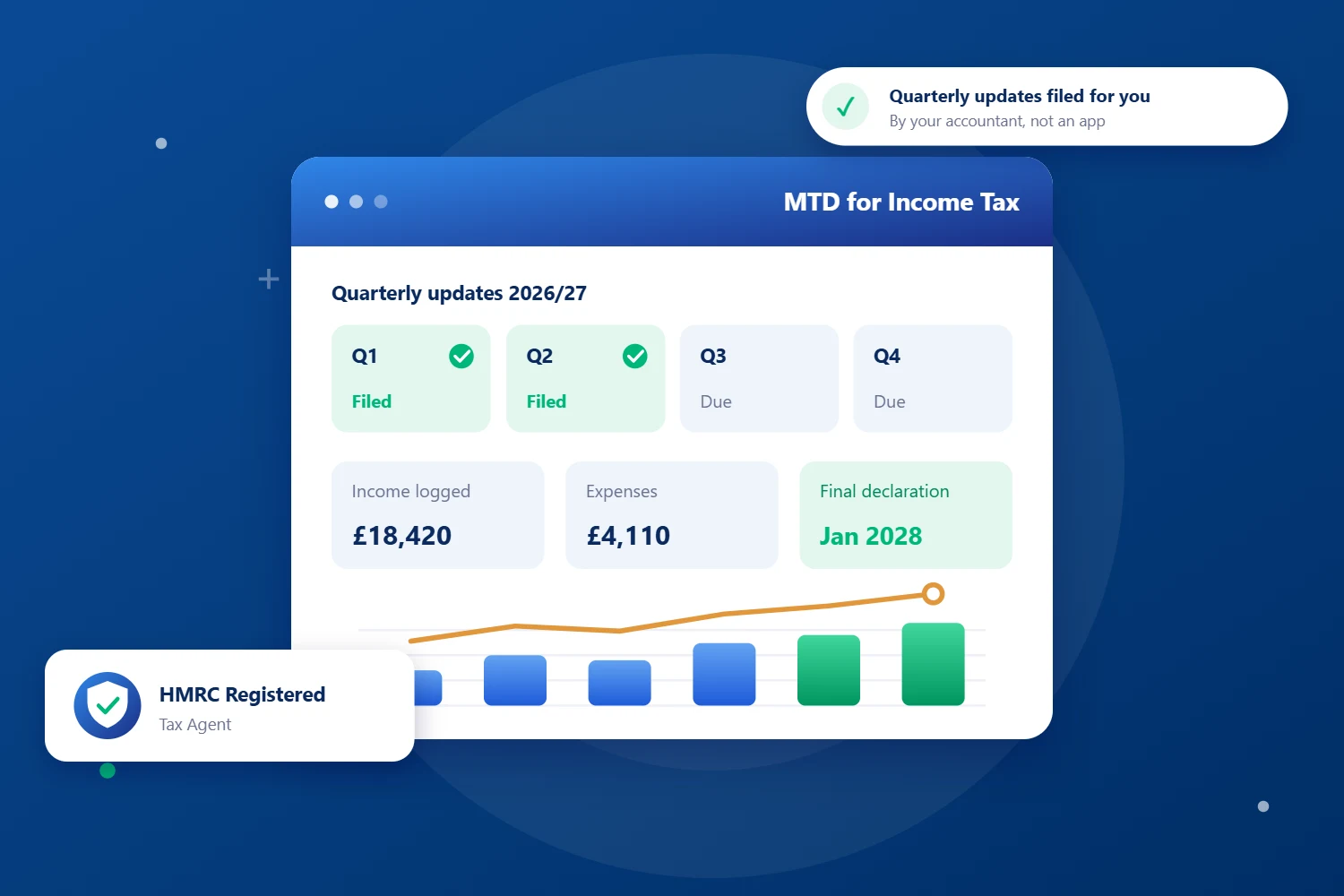
Choose the MTD support that fits your business. Our straightforward pricing gives you professional accounting support without complicated packages or hidden costs.
2026/27 Self Assessment Under MTD for Income Tax: What’s Different
By Marina Jahan · Reviewed by Shamayun Chowdhury, CIMA · Tax year 2026/27 · Last reviewed [REVIEW DATE]
Quick answer: what does Making Tax Digital for Income Tax mean?
For sole traders and landlords, MTD for Income Tax replaces the old way of reporting income to HMRC. Rather than one annual Self Assessment return built from a year of paperwork, you log income and costs in software as they happen, send a running summary every three months, and finish with a tax return. It became compulsory on 6 April 2026 for people whose trade and rental takings were over £50,000.
On this page
- What is MTD for Income Tax?
- Self Assessment vs Making Tax Digital: what changes, what stays
- Which taxpayers must follow Making Tax Digital for Income Tax
- A year under MTD ITSA, month by month
- What goes in the updates, and what waits for the tax return
- MTD income tax and your payment dates
- Getting started in five moves
- Help from MTDFix
- MTD for Income Tax FAQs
What is MTD for Income Tax?
MTD for Income Tax is the stage of HMRC’s digital programme that reaches individuals, rather than businesses registered for VAT. You’ll often hear HMRC and accountants call it MTD ITSA, the abbreviated form of Making Tax Digital for Income Tax Self Assessment. You may also see it described as making income tax digital, or as Making Tax Digital personal tax, because it applies to people in their own name rather than to companies.
Under Making Tax Digital income tax rules, three groups of income sit inside it: profits from self-employment, rent from UK property, and rent from property abroad for UK residents. Everything else on your return, such as a salary, pension or dividends, stays outside the quarterly cycle.
For how MTD began with VAT and where it is heading, read our overview of what is Making Tax Digital. This page sticks to one part of the scheme: Making Tax Digital (MTD) for Income Tax.
Self Assessment vs Making Tax Digital: what changes, what stays
Making Tax Digital for Self Assessment doesn’t replace the system. The way you report within it is rebuilt from the ground up. Comparing the two in parallel makes the contrast clear.
|
Traditional Self Assessment |
Self Assessment under MTD |
|
|---|---|---|
|
How records are kept |
Any method: paper, spreadsheet, shoebox |
Digitally, in HMRC-compatible software |
|
Contact with HMRC during the year |
None |
A summary every quarter |
|
How the return is sent |
HMRC online or software |
Through your MTD software only |
|
Late-filing sanction |
Fixed fines |
Penalty points, then £200 |
|
Tax rates and allowable expenses |
Unchanged |
|
|
When you pay |
Unchanged: 31 January, plus 31 July for payments on account |
|
So the self assessment Making Tax Digital shift is about timing and method. Nothing changes in how your profit is calculated or how the tax on it is arrived at.
Which taxpayers must follow Making Tax Digital for Income Tax
What decides whether you cross the Making Tax Digital for Income Tax threshold is your gross income, with profit playing no part. HMRC adds your self-employed turnover to your rent from a return you have already filed. Over £50,000 on the 2024/25 return brought people in from 6 April 2026; over £30,000 on the 2025/26 return brings them in from April 2027; and over £20,000 follows in April 2028. The rule for joint property, lodgers and overseas lets is explained in our page on Making Tax Digital thresholds.
Not caught yet but want to get ahead? You can choose to use Making Tax Digital for Income Tax voluntarily before your mandatory date. Joining early lets you get used to the software while nothing is at stake, though you should check HMRC’s current conditions for volunteers first.
People who stay outside it: employees with no self-employed or rental income, general partnerships (no date set), limited companies, and anyone HMRC has granted an exemption.
Legal basis: SI 2026/336; practical guidance: HMRC’s sign-up guidance on GOV.UK.
A year under MTD ITSA, month by month
An MTD ITSA year has five filing points and two payment points. Here is how 2026/27 looks for someone who joined in April 2026:
April to July 2026: records kept in software from the first day of the tax year.
By 7 August 2026: first update, covering April to early July.
By 7 November 2026: second update, now covering the year to early October.
By 31 January 2027: tax for 2025/26 paid under the old system, plus your first payment on account for 2026/27 if one applies.
By 7 February 2027: third update, year to early January.
By 7 May 2027: fourth update, closing the tax year.
By 31 July 2027: second payment on account, if one applies.
By 31 January 2028: 2026/27 tax return through your software, and any balance paid.
Each update runs from the start of the tax year to the end of the latest quarter, so it’s a running total rather than a fresh three-month snapshot. That design means a slip in one quarter is fixed in the next one instead of being resubmitted. Your software can also show an in-year estimate of what you’re likely to owe.
Deadlines: HMRC’s penalty guidance on GOV.UK.
What goes in the updates, and what waits for the tax return
The quarterly updates only carry your trading and property figures. Anything else waits for the end of the year.
In each quarterly update
- Self-employed income and costs, by HMRC category
- UK rental income and costs
- Overseas rental income and costs
Only in the tax return
- Salary, pensions, dividends, savings interest
- Capital allowances and other year-end adjustments
- Reliefs such as pension contributions and Gift Aid
Keeping the day-to-day records that feed those updates is its own subject, covered in our guide to Making Tax Digital quarterly returns. Choosing a product is covered in our guide to MTD for Income Tax software.
MTD income tax and your payment dates
MTD income tax reporting doesn’t bring payments forward. The money still leaves your account on the Self Assessment dates: a balancing payment and first payment on account on 31 January, and a second payment on account on 31 July where those apply.
What quarterly reporting gives you is warning. With the figures never more than three months out of date, a large bill shouldn’t come as a surprise, and you can put money aside each month.
Getting started in five moves
- Confirm your start date from the gross figures on your latest return.
- Check your HMRC online account and post: since September 2026 HMRC has been enrolling people it believes should already be in.
- Sign up, or check the sign-up HMRC made for you. Our guide to signing up for Making Tax Digital walks through it.
- Pick HMRC-compatible software and connect it to your account.
- Record from 6 April of your first year, and diary the four update dates plus 31 January.
Help from MTDFix
HMRC Making Tax Digital for Income Tax can be run yourself. If you’d rather hand it over, MTDFix does the whole cycle for sole traders and landlords across the UK, from sign-up to the final return, with every update checked by an accountant before it goes to HMRC.
MTD for Income Tax
£15 a month
- Sign-up and agent authorisation
- Software included
- Every quarterly update sent
- Year-end tax return
Still on ordinary Self Assessment
£7.50 a month
- Annual tax return
- Expenses reviewed
- A heads-up before MTD reaches you
For the full service, talk to a Making Tax Digital accountant at MTDFix.
Find out your MTD for Income Tax start date
Share the turnover and rent figures from your last return. We’ll confirm when you join and quote a fixed monthly price up front.
📞 0116 403 0595 | 📧 info@mtdfix.com | 🌐 mtdfix.com
MTDFix, 6 Egginton Street, Leicester, LE5 5BA · Working with clients UK-wide
MTD for Income Tax FAQs
What is Making Tax Digital for Income Tax, in one sentence?
It’s HMRC’s requirement for qualifying sole traders and landlords to keep digital records, send quarterly updates and file their year-end return through compatible software.
Is MTD ITSA the same as Making Tax Digital for Income Tax?
Yes. MTD ITSA is the shorthand used by HMRC and accountants; the full name spells out that it covers Income Tax Self Assessment.
Does Making Tax Digital for Income Tax Self Assessment apply if I’m employed too?
Only through your side income. Your salary is ignored for the threshold, but if your self-employed takings plus any rent pass the limit, those income sources join MTD.
Can I still file my tax return on the HMRC website?
Not once you’re inside MTD for Income Tax. Your end-of-year return goes through the same compatible software as your quarterly updates.
What if I get a quarterly update wrong?
Correct it in your software and the change flows into the next update, because each one is a running total from the start of the tax year.
Do partnerships use MTD for Income Tax?
Not yet. HMRC hasn’t set a date for general partnerships, so partnership profits stay on the normal Self Assessment route for now.
Is there any leniency in the first year?
Yes, for quarterly updates. In 2026/27 a late update adds no penalty point, but you still have to send it before your tax return, and late returns or payments are penalised as usual.
An overview of the 2026/27 Income Tax rules, not advice for your own circumstances. Speak to an accountant if your situation is complicated.
About the author
Written by Marina Jahan · Reviewed by Shamayun Chowdhury
Written by Marina Jahan, MTDFix.
Reviewed by Shamayun Chowdhury, Senior Accountant at Major Accountancy and Lecturer in Accounting at Nottingham Trent University. CIMA qualified. Based in Leicester, England.
- CIMA qualified accountant with 15+ years of UK practice experience
- Lecturer in Accounting, Nottingham Trent University
- Senior Accountant at Major Accountancy, Leicester
- 500+ UK businesses supported across Self Assessment, Corporation Tax, VAT, and MTD compliance
- LinkedIn: Shamayun Chowdhury on LinkedIn
- Facebook: Shamayun Chowdhury on Facebook
Last reviewed: [REVIEW DATE]