
By Marina Jahan · Published: 12 November 2026 · Last reviewed: November 2026 · 2026/27 tax year
For most limited company directors, dividends are the main way profit reaches their own bank account. So when dividend tax goes up by two percentage points, it is felt directly. What many directors have not yet noticed is when they will actually pay for it: not this January, but in January 2028.
This UK guide explains the dividend tax increase for 2026/27 in pounds, not just percentages. It shows what the rise costs two typical directors, why most of it lands in one Self Assessment payment, how it affects the salary and dividend mix, and the two further changes coming in 2027 and 2028. For the full table of rates and bands, see our sister firm’s guide to dividend tax rates for 2026/27.
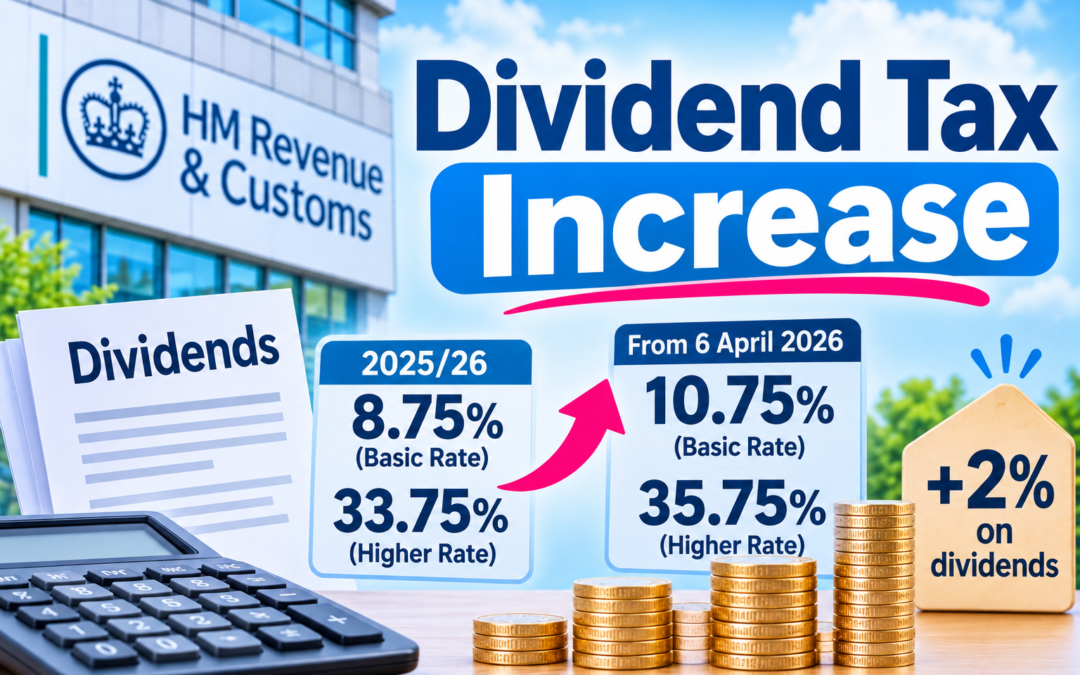
- Dividend tax rose on 6 April 2026: 10.75% in the basic rate band and 35.75% in the higher rate band. The additional rate is unchanged at 39.35%.
- A director taking a £12,570 salary and £50,000 of dividends pays £990 more a year.
- Because payments on account are based on last year’s bill, the extra tax mostly falls due on 31 January 2028.
- Budget 2026 left dividend tax alone, but property and savings income will be taxed at 24%, 44% and 49% from April 2027.
- Dividends do not count towards the Making Tax Digital income test, and they are not part of quarterly updates.
The Dividend Tax Increase in Brief
The change was announced at Budget 2025 and set out in an HMRC policy paper. It applies to dividends received on or after 6 April 2026.
| Band | 2025/26 | From 6 April 2026 | Change |
|---|---|---|---|
| Ordinary rate (basic rate band) | 8.75% | 10.75% | +2 points |
| Upper rate (higher rate band) | 33.75% | 35.75% | +2 points |
| Additional rate | 39.35% | 39.35% | No change |
| Dividend allowance | £500 | £500 | No change |
The first £500 of dividends each year is taxed at 0%, but it still uses up part of your tax band. Dividends inside an ISA or a pension are not affected. HMRC estimates that by 2029/30 about 3.9 million people will pay more because of the change. GOV.UK’s Tax on dividends page has the basic rules.
Who feels the dividend tax increase most?
- Owner-managed company directors who take most of their income as dividends.
- Investors with shares outside an ISA or pension, once their dividends pass £500 a year.
- Higher rate taxpayers, because 2 points on a larger slice of income adds up quickly.
- Scottish taxpayers too: dividend rates are set for the whole UK, although Scottish income tax bands apply to salary and other non-savings income.
What the Dividend Tax Increase Costs a Director
Percentages hide the real effect, so here are two typical directors. Both pay themselves a salary of £12,570, which uses up their Personal Allowance, and take the rest as dividends. The figures are illustrative and use rates for England, Wales and Northern Ireland.
Aisha: £50,000 of dividends
| Aisha | 2025/26 | 2026/27 |
|---|---|---|
| £500 dividend allowance | £0 | £0 |
| £37,200 in the basic rate band | £3,255.00 | £3,999.00 |
| £12,300 in the higher rate band | £4,151.25 | £4,397.25 |
| Total dividend tax | £7,406.25 | £8,396.25 |
Aisha (invented) pays £990 more in 2026/27 for exactly the same dividends.
Ben: £100,000 of dividends
Ben (invented) takes £100,000 of dividends on top of the same salary. His total income of £112,570 is over £100,000, so his Personal Allowance is cut by £1 for every £2 over the limit, from £12,570 to £6,285. That means £6,285 of his salary is taxed at 20%, costing £1,257, before any dividend tax.
| Ben | 2025/26 | 2026/27 |
|---|---|---|
| Dividend tax | £25,852.50 | £27,842.50 |
| Increase | £1,990 |
Ben also loses part of his Personal Allowance, which is not new for 2026/27 but makes the effective rate on income between £100,000 and £125,140 very high. Some directors manage this by timing dividends or making pension contributions.
The bigger the dividend, the bigger the rise: roughly 2% of every pound above the £500 allowance, up to the additional rate threshold.
Why the Dividend Tax Increase Hits Your January 2028 Tax Bill
Most directors pay their dividend tax through Self Assessment, and that usually means payments on account. Each payment on account is half of the previous year’s bill. Your payments for 2026/27 are therefore based on your 2025/26 bill, which was worked out at the old, lower rates.
The result is that the extra tax is not collected during 2026/27 at all. It arrives in one go with the balancing payment on 31 January 2028, at the same time as the first payment on account for the next year, which is now based on the higher bill.
Aisha’s payments, date by date
| Date | What is due | Amount |
|---|---|---|
| 31 January 2027 | First 2026/27 payment on account (half of £7,406.25) | £3,703.12 |
| 31 July 2027 | Second 2026/27 payment on account | £3,703.12 |
| 31 January 2028 | 2026/27 balancing payment (£990) plus first 2027/28 payment on account (£4,198.12) | £5,188.12 |
| 31 July 2028 | Second 2027/28 payment on account | £4,198.12 |
This assumes Aisha takes the same dividends in both years, has no other income, and pays exactly on time. The January 2028 payment is £1,485 higher than her January 2027 payment on account, almost entirely because of the rate rise.
Do not cut your payments on account below what you expect to owe to soften the blow. If you reduce them and your final bill is higher, HMRC charges late payment interest on the shortfall from the original due dates. The rate is 7.75% until 23 November 2026 and 8% from 24 November 2026, according to HMRC.
Salary vs Dividends After the Increase
The rise narrows the gap between dividends and salary slightly, but for most small company directors the basic pattern still holds. The usual approach is a salary around the Personal Allowance, with the rest taken as dividends. The figures for 2026/27 that matter are:
| Item | 2026/27 |
|---|---|
| Personal Allowance and employee NI threshold | £12,570 |
| Employer NI | 15% on salary above £5,000 |
| Employment Allowance | £10,500, but not for a company whose only employee paying employer NI is a director |
| Corporation Tax | 19% up to £50,000 profit, 25% above £250,000, marginal relief in between |
A one-director company cannot use the Employment Allowance, so a salary above £5,000 creates some employer NI. On a £12,570 salary that is (£12,570 − £5,000) × 15% = £1,135.50 a year, although the salary and the NI are both deductible when working out Corporation Tax. Many directors accept that cost because a salary of £12,570 also protects their State Pension record and is deductible for Corporation Tax.
Dividends vs employer pension contributions
Every pound taken as a dividend has already borne Corporation Tax, and then bears dividend tax. Take £10,000 of company profit and a higher rate director:
| Route | What the director ends up with |
|---|---|
| Dividend, company paying 25% CT | £7,500 dividend, £4,818.75 after 35.75% tax |
| Dividend, company paying 19% CT | £8,100 dividend, £5,204.25 after 35.75% tax |
| Employer pension contribution | £10,000 in the pension, usually deductible for CT, taxed later under pension rules |
A pension is not cash in hand, and the right mix depends on your age, plans and income. This is general information, not advice, so speak to an accountant before changing how you pay yourself.
Budget Tax on Dividends: What Budget 2026 Did and Did Not Change
The Budget on 28 October 2026 did not raise dividend tax again. GOV.UK’s Budget 2026 rates annex shows the same figures for 2027/28: a £500 allowance and rates of 10.75%, 35.75% and 39.35%. Corporation Tax rates and limits are also unchanged.
The bigger change is to other income. From 6 April 2027, property and savings income will be taxed at their own rates of 24%, 44% and 49%, separate from the main income tax rates. Budget 2025 had planned 22%, 42% and 47%, and Budget 2026 added a further two points, according to Deloitte. The property rates apply in England, Wales and Northern Ireland; Scotland and Wales can set their own property income rates.
Example: Aisha with a rental property
Suppose Aisha also owns a flat personally, with £15,000 of rental profit. With the same salary and dividends, her property income is taxed in the basic rate band:
| Aisha with £15,000 rental profit | 2026/27 | 2027/28 |
|---|---|---|
| Tax on rental profit | £3,000 (20%) | £3,600 (24%) |
| Dividend tax | £12,146.25 | £12,146.25 |
| Total | £15,146.25 | £15,746.25 |
That is £600 more from April 2027, before any finance cost credit. Directors with savings interest above their personal savings allowance will see a similar rise on that income.
The April 2028 Distributions Reform
Budget 2026 also confirmed a reform of how certain company payments to shareholders are taxed, described in HM Treasury’s factsheet on modernising the distributions framework. From April 2028, the aim is to tax non-dividend payments to shareholders more consistently, whatever legal form they take.
What is known so far:
- dividend and Capital Gains Tax rates are not changing as part of this reform;
- returns of capital after a company reorganisation are expected to be limited to the capital originally subscribed;
- the conditions for capital treatment on share buybacks will be consulted on again;
- draft legislation is due for technical consultation in 2027.
Until the draft rules are published, treat any claim about how the reform affects your exit plans as provisional. If you are planning a buyback, a reorganisation or a sale in the next few years, take advice early.
Other knock-on effects
- Director’s loans: the s455 charge on overdrawn loan accounts follows the upper dividend rate, so it is now 35.75%. See our sister firm’s guide to director’s loan account tax.
- Income tests: dividends count towards adjusted net income, which decides the High Income Child Benefit Charge and the £100,000 Personal Allowance taper. Our guide to HMRC Child Benefit changes explains the charge.
- Selling the company: check the current Business Asset Disposal Relief rules in our sister firm’s guide to BADR.
Dividends, Self Assessment and Making Tax Digital
Making Tax Digital for Income Tax is built around self-employment and property income. According to GOV.UK’s guide to qualifying income, dividends are not counted when working out whether you must join MTD, and they are not part of the quarterly updates you send.
That does not mean dividends disappear from view. If you are in MTD because you also run a sole trade or let property, your dividends are still taxed for the year, and they are brought into your year-end tax position alongside your other income. If you are not in MTD, they go on your Self Assessment return as now. Either way, the January payment deadline is the same.
A director with a rental property needs to watch both sides: the rent may bring them into MTD from April 2027 or April 2028, while the dividends stay outside the MTD test. See our guide to MTD for Income Tax for the thresholds.
What Directors Can Do Now
- Work out your 2026/27 dividend tax using the new rates, not last year’s bill.
- Set aside the difference each month so the January 2028 payment is not a shock.
- Review your salary and dividend mix with your accountant, including pension contributions.
- Clear any overdrawn director’s loan within nine months of the year end to avoid s455 at 35.75%.
- Check rental and savings income for the 2027 rate rise if you hold them personally.
- Watch for the 2027 draft rules on distributions if you plan a buyback or reorganisation.
Common Dividend Tax Increase Mistakes
| Mistake | What actually happens | Do this instead |
|---|---|---|
| Budgeting from last year’s bill | The increase arrives in one lump in January 2028 | Recalculate at the new rates |
| Treating the £500 allowance as extra band | It still uses up part of your basic rate band | Include it when counting your band |
| Cutting payments on account to cope | Interest runs on any shortfall | Pay as set, or reduce only with evidence |
| Assuming Budget 2026 raised dividends again | Rates for 2027/28 are unchanged | Check the Budget rates annex |
| Forgetting rental income | Property tax rises to 24%, 44% and 49% from April 2027 | Plan for both changes |
Dividend Tax Increase FAQs
How much has dividend tax increased?
By two percentage points in the basic and higher rate bands, to 10.75% and 35.75%. The additional rate is unchanged at 39.35%.
When did the dividend tax increase start?
On 6 April 2026, for dividends received in the 2026/27 tax year onwards.
Did Budget 2026 increase dividend tax again?
No. The Budget 2026 rates annex keeps the 2027/28 dividend rates and the £500 allowance the same as 2026/27.
Is the dividend allowance still £500?
Yes. The first £500 of dividends each year is taxed at 0%, but it still uses part of your tax band.
Why is my January 2028 tax bill so high?
Your 2026/27 payments on account were based on your 2025/26 bill at the old rates. The extra tax is collected in the balancing payment on 31 January 2028, alongside a higher payment on account.
Should directors take salary instead of dividends now?
Not automatically. A salary around £12,570 plus dividends is still common, but the best mix depends on your circumstances. Speak to an accountant.
Does the dividend tax increase affect ISAs and pensions?
No. Dividends inside an ISA or a pension are not taxed, so the increase does not apply to them.
Do dividends count towards Making Tax Digital?
No. MTD qualifying income is self-employment and property income only. Dividends are taxed at the year end, not in quarterly updates.
What is changing for company distributions in 2028?
From April 2028, certain non-dividend payments to shareholders are due to be taxed more consistently. Dividend and CGT rates are not changing, and draft rules are due in 2027.
Will savings and rental income tax go up too?
Yes. From 6 April 2027, savings and property income will be taxed at 24%, 44% and 49%.
Final Verdict on the Dividend Tax Increase
The dividend tax increase costs a typical director somewhere between a few hundred and a few thousand pounds a year, and most of it will be collected in one payment on 31 January 2028.
Budget 2026 left dividend rates alone, but rental and savings income face a bigger rise from April 2027, and the 2028 distributions reform is still taking shape. Recalculate now, set the money aside and review your pay mix before the next tax year.
MTDFix helps directors plan their pay and file on time.
Written by Marina Jahan using GOV.UK, HMRC and HM Treasury sources, with figures as published at 12 November 2026. The worked examples use invented names, rates for England, Wales and Northern Ireland, and our own calculations. The 2028 distributions reform still needs legislation. This guide is general information, not personal tax advice.