
Making Tax Digital VAT Returns: Rules, Records and Deadlines
By Marina Jahan ·
Reviewed by Shamayun Chowdhury, CIMA ·
Tax year 2026/27 · Last reviewed [22 September 2026]
Quick answer
Making Tax Digital VAT returns must be prepared from digital records and sent to HMRC through compatible software. Every VAT-registered business has been inside these rules since 1 April 2022, whatever its turnover. The old HMRC portal route closed, so VAT and Making Tax Digital now travel together for anyone holding a VAT number.
Is Making Tax Digital for VAT compulsory?
Yes, for every business with a VAT registration. The making tax digital VAT HMRC rules, sometimes written as HMRC VAT Making Tax Digital, arrived in two waves: April 2019 for businesses trading above the registration threshold, then April 2022 for everyone else with a VAT number, including voluntary registrations.
That second date is the one people forget. Register voluntarily on £40,000 of sales and UK VAT MTD applies to you from the first return, exactly as it does to a business turning over millions. The current registration threshold is £90,000 of taxable turnover on a rolling twelve-month basis, but crossing it is not what triggers the digital rules. Holding the registration is.
A small number of businesses sit outside, mainly where HMRC has granted an exemption on grounds such as age, disability, remoteness, religious belief or insolvency. As with every part of the scheme, you apply and HMRC decides.
Making Tax Digital VAT requirements
Three obligations sit at the heart of HMRC Making Tax Digital for VAT.
| Requirement | What it means day to day |
|---|---|
| Digital records | Sales and purchases recorded electronically as they happen, not written up from paper at quarter end |
| Compatible software | A product that talks to HMRC directly, or bridging software attached to your spreadsheet |
| Digital links | Figures move between systems electronically. Retyping or copying a total by hand breaks the chain |
Nothing in the making tax digital UK VAT rules, or the making tax digital VAT UK guidance you will see elsewhere, changes how VAT itself works. Your scheme, your rates, your reclaim position and your deadlines are untouched. What changed is the plumbing between your books and HMRC.
The records HMRC expects, and the VAT notice behind them
The rulebook is the making tax digital VAT notice, published by HMRC as VAT Notice 700/22. Parts of it carry the force of law, so it is worth a read before you design your process. According to that VAT notice, Making Tax Digital records must include:
- Your business name, principal address and VAT registration number
- The VAT scheme you use, such as standard, cash accounting or flat rate
- For each sale: the tax point, the value excluding VAT and the rate charged
- For each purchase: the tax point, the value and the input tax you intend to reclaim
- Any adjustments, summarised, with the workings kept outside the digital records if you prefer
Search for “VAT notice making tax digital” and you land on the same document; there is only one. Two practical points save most of the arguments. First, you do not have to store scanned invoices digitally, though many businesses do; the requirement is that the transaction record itself is electronic. Second, a spreadsheet is still allowed, so long as bridging software carries the figures to HMRC without anyone retyping them.
How to make tax digital for VAT: submission in practice
Making Tax Digital VAT submission follows the same rhythm each quarter.
- Record as you go. Sales and purchases land in your software during the period, ideally through a bank feed.
- Reconcile before the period closes. Check the bank, chase missing purchase invoices, review anything uncategorised.
- Review the nine boxes. Your software builds the return; you check that the figures make sense against the quarter’s trading.
- Submit through the software. The return travels to HMRC directly. Submitting VAT returns Making Tax Digital style means there is no separate login to the old portal.
- Pay by the deadline. For most businesses the return and payment are both due one calendar month and seven days after the period ends.
Each VAT return Making Tax Digital sends on your behalf carries a receipt number when HMRC accepts it, and HMRC Making Tax Digital VAT returns are only counted as filed once that arrives. Keep it. It is the quickest evidence that a return was filed on time if a query arises later.
Making Tax Digital VAT for small businesses
For a small business, the cost of MTD is rarely the software. It is the habits. Three things make the difference between a smooth quarter and a lost weekend:
- A separate business bank account, feeding transactions straight into the software.
- Weekly, not quarterly, bookkeeping. Twenty minutes a week keeps the VAT return honest and the reclaim complete.
- A rule for awkward items, such as fuel, entertaining and mixed-use purchases, applied consistently rather than reinvented each quarter.
Illustrative example
A café registered voluntarily for VAT to reclaim tax on its fit-out. Turnover is £62,000, well under the registration threshold, so the owner assumed the digital rules did not apply. They do, from the first return after registration. Once the till system was linked to the bookkeeping software, each quarterly return took about half an hour. Details are invented to explain the rule.
Is Making Tax Digital only for VAT?
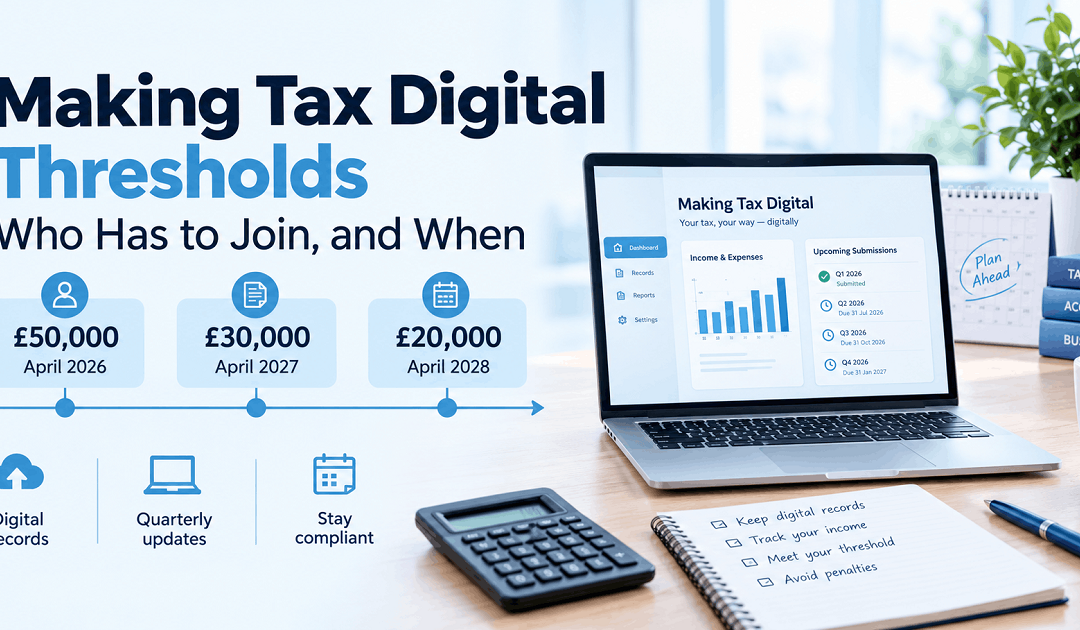
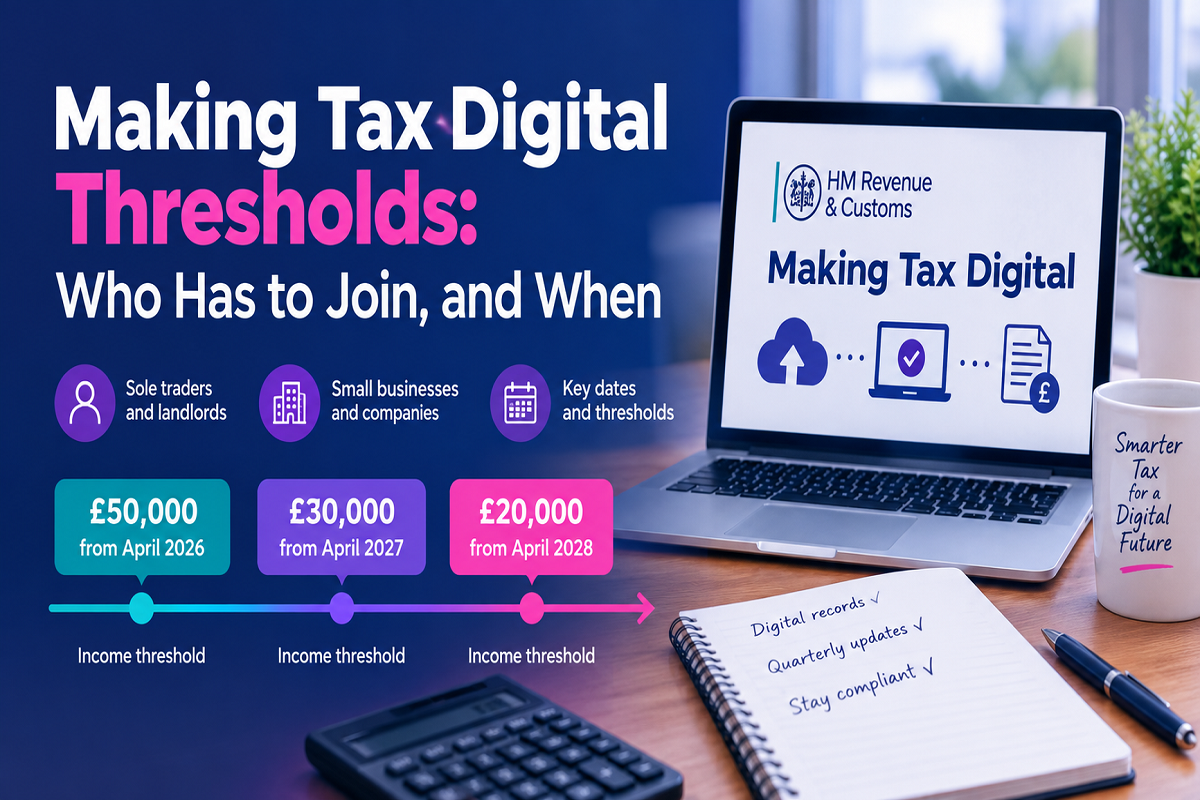
No, not any more. UK Making Tax Digital VAT duties were the first stage, and for several years it was the whole of Making Tax Digital in practice. Income Tax joined on 6 April 2026 for sole traders and landlords with gross trade and rental income above £50,000, with lower limits following in 2027 and 2028.
The two parts run side by side and are judged separately. A VAT-registered builder files quarterly VAT returns under one set of rules and, if his income clears the limit, quarterly Income Tax updates under another. Our guides to MTD for Income Tax and the Making Tax Digital thresholds cover that side.
What late VAT returns cost
Since January 2023, late VAT returns have been handled through penalty points rather than automatic surcharges. Each return filed after its deadline adds a point. Nothing is charged for the point itself, but once a business filing quarterly reaches four points, a £200 penalty follows, and another £200 lands with each further late return while the points remain.
Paying late is treated separately. Charges begin once the payment is overdue, increase if it is still outstanding after the first month, and interest runs alongside them. The safest approach is simple: file on time even when you cannot pay in full, then talk to HMRC about the balance.
There are also penalties specific to the digital rules themselves, for filing without functional compatible software or for failing to keep digital records and links. In practice HMRC has said it will not chase record-keeping penalties where a business is clearly trying to comply.
Help from MTDFix
MTDFix looks after VAT and Making Tax Digital together for small businesses across the UK. We set up the software, keep the records, prepare each return for your approval and file it as your HMRC agent, so nothing turns on you remembering a deadline in a busy month.
VAT returns
Fixed quote
- Software set up and linked to HMRC
- Bookkeeping kept current
- Quarterly returns prepared and filed
- Scheme review, including flat rate and cash accounting
Priced on transaction volume. Ask for a figure before you commit.
Also inside MTD for Income Tax
£15 a month
- Quarterly updates filed
- Software included
- Year-end tax return
Want the wider service? Speak to a Making Tax Digital accountant at MTDFix.
Hand your VAT returns to us
Tell us your VAT scheme and roughly how many transactions you handle each quarter, and you will get a fixed quote before any work starts.
📞 0116 403 0595 | 📧 info@mtdfix.com | 🌐 mtdfix.com
MTDFix, 6 Egginton Street, Leicester, LE5 5BA · Working with businesses UK-wide
VAT FAQs
Can I still file a VAT return on the HMRC website?
No. Returns now leave your software and travel to HMRC through its API. The old manual route is closed to VAT-registered businesses.
Is a spreadsheet still acceptable?
Yes, paired with bridging software. The link between the spreadsheet and HMRC has to be digital, so nobody retypes the nine box figures.
Does the flat rate scheme change what I keep?
The records are lighter, because you are not reclaiming input tax on most purchases, but the digital record and digital submission rules still apply in full.
I deregistered from VAT. What happens to the digital rules?
They stop with the registration. Keep the records you already hold for the statutory period, normally six years, in case HMRC asks.
Do annual accounting scheme users have to comply?
Yes. One return a year rather than four, but it still comes from digital records and goes through compatible software.
Can my accountant file the return for me?
Yes, once you authorise them as your agent. They file from their own software using your digital records, and you stay responsible for the figures.
General guidance on the VAT rules as they stand in 2026, not advice for your own business. Schemes, partial exemption and sector rules can change the answer, so take advice where your position is unusual.
Sources