
By Marina Jahan · Published: 12 November 2026 · Last reviewed: November 2026 · 2026/27 tax year
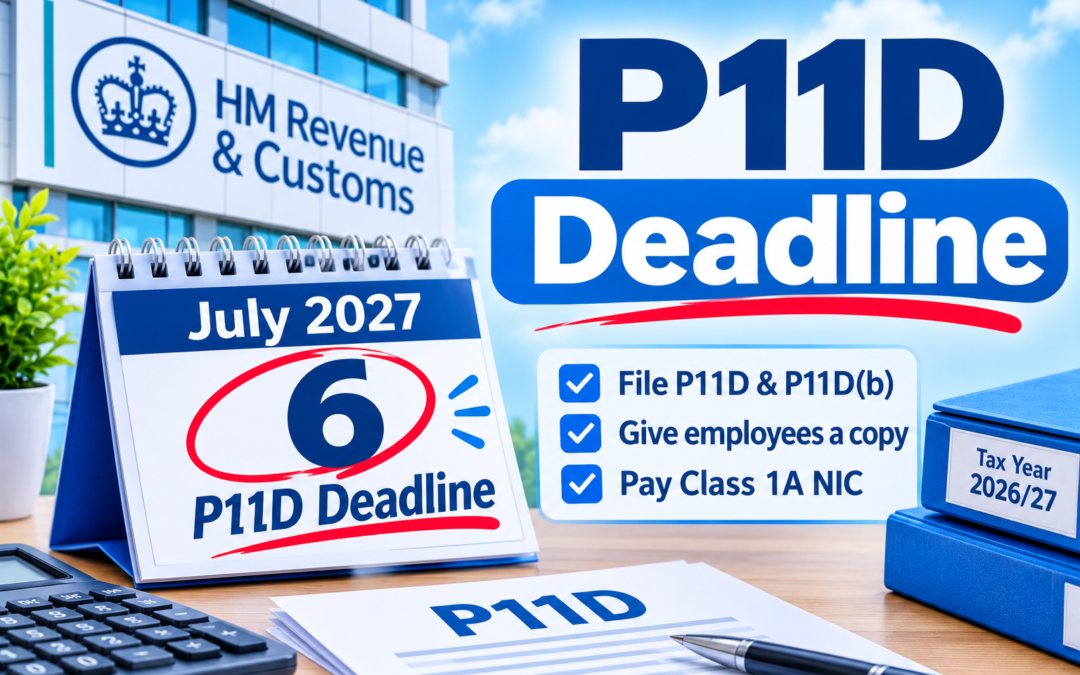
If your company provides a car, health insurance or other perks, the P11D deadline 2027 is the date to put in the diary: 6 July 2027, for benefits provided in the 2026/27 tax year. Miss it and HMRC charges a penalty for every month the return is late, however small your business. The 2026 deadline has now passed, and the next one comes just as payrolling of benefits begins.
This guide sets out the P11D deadline for the 2026/27 tax year, the Class 1A payment dates, the penalties, how to correct a mistake, and how mandatory payrolling of benefits changes the dates from April 2027. It is written for small company owners and directors who handle their own benefits reporting. For what a P11D is and what goes on it, see our sister firm’s guide to the P11D form.
- The P11D deadline for 2026/27 is 6 July 2027 for P11Ds, the P11D(b) and employee copies.
- Class 1A National Insurance is due by 22 July 2027 electronically, or 19 July 2027 by cheque.
- A late P11D(b) costs £100 per 50 employees for each month or part month it is late.
- P11Ds must be filed online, and HMRC asks for all P11Ds and the P11D(b) to be sent together in one submission.
- From 6 April 2027, mandatory payrolling begins for company cars, car fuel, vans, van fuel and employer-provided medical benefits.
P11D Deadline 2027: The Key Dates
GOV.UK sets out the deadlines for expenses and benefits. They fall after the end of each tax year, so the dates below are for benefits provided between 6 April 2026 and 5 April 2027.
| What you need to do | Deadline for 2026/27 |
|---|---|
| File a P11D for each employee with benefits or non-exempt expenses | 6 July 2027 |
| File the P11D(b), reporting total Class 1A owed | 6 July 2027 |
| Give each employee a copy of their P11D information | 6 July 2027 |
| Pay Class 1A National Insurance electronically | 22 July 2027 |
| Pay Class 1A National Insurance by cheque | 19 July 2027 |
| Pay tax and Class 1B under a PAYE Settlement Agreement | 22 October 2027 |
The 2025/26 deadlines were 6 July and 22 July 2026. If you have not filed those yet, do it straight away, because penalties are already running.
When 6 July falls on a weekend, do not wait for the next working day. File early in the week before, especially if you rely on software or an accountant who will be busy around the deadline.
What You Must File by the P11D Deadline
There are three things to deliver by the P11D deadline:
- A P11D for each employee or director who received taxable benefits or non-exempt expenses, unless you registered those benefits for payrolling before the tax year began.
- One P11D(b) for the whole PAYE scheme, showing the total Class 1A National Insurance due. You need it if you provided benefits, non-exempt expenses or payrolled any benefits.
- A copy of the information for each employee, so they can check their tax code and any tax return.
For the 2026/27 tax year, employers had to register for voluntary payrolling by 5 April 2026, as ICAEW and HMRC reminded employers. If you did not register by that date, you must report your 2026/27 benefits using the P11D and P11D(b) process.
All P11Ds and the P11D(b) must be submitted online, through HMRC’s PAYE Online service or commercial payroll software. Paper forms are no longer accepted. HMRC’s October 2026 Employer Bulletin also reminds employers to send everything together in one submission, once every form is complete, rather than spreading it over several days.
What does not need to go on a P11D
Not every perk has to be reported. You generally do not need to include:
- qualifying business expenses that are covered by an exemption, such as business travel reimbursed in line with HMRC’s rules;
- employer contributions to a registered pension scheme for the employee;
- one employer-provided mobile phone per employee, subject to HMRC’s conditions. A cash allowance or reimbursement of an employee’s own phone contract is not automatically covered;
- trivial benefits that cost £50 or less, are not cash or a cash voucher, and are not a reward for work or required by the contract;
- qualifying annual staff functions, such as a Christmas party, where the combined cost of exempt annual functions is no more than £150 per head for the tax year and the event is open to all employees, or all employees at a particular location;
- anything covered by a PAYE Settlement Agreement, which has its own October deadline;
- benefits you have registered to payroll, although they still count on the P11D(b) for Class 1A.
If you are unsure whether something is exempt, check HMRC’s guidance on expenses and benefits before leaving it off, because a missing benefit is one of the most common reasons for an amended return.
Paying Class 1A National Insurance
Class 1A is the employer’s National Insurance on benefits in kind. For 2026/27, Class 1A National Insurance is generally charged at 15% on the taxable value of benefits liable to Class 1A. This can include both benefits reported on P11D and benefits that have been payrolled, as HMRC’s employer further guide explains.
Employers report their total Class 1A liability on the P11D(b) by 6 July and pay it by 22 July, or 19 July by cheque.
Worked example: Priya Ltd, a sole-director company
Priya (invented) is the only director of her company, which did not register for voluntary payrolling for 2026/27. During the year the company provides her with a company car and private medical insurance costing £1,200.
For illustration, assume the £1,800 company car figure is the correctly calculated taxable cash equivalent for the full tax year, and that both benefits are fully liable to Class 1A National Insurance. The example excludes any employee contributions or other adjustments.
| Priya Ltd, 2026/27 | Amount |
|---|---|
| Company car (assumed cash equivalent) | £1,800 |
| Private medical insurance | £1,200 |
| Total benefits | £3,000 |
| Class 1A at 15% | £450 |
| File P11D and P11D(b) by | 6 July 2027 |
| Pay Class 1A by | 22 July 2027 |
Priya also pays income tax on the £3,000 of benefits, usually through her tax code or her Self Assessment return. From April 2027, both of her benefits fall into the first phase of mandatory payrolling, so the 2026/27 return will be her company’s last P11D for them.
How the P11D affects employees’ tax
HMRC uses the P11D figures to adjust each employee’s tax code for future years, so the tax on a benefit is collected through their pay. If a benefit is reported late, or not at all, the employee can face an unexpected underpayment later. Giving staff their copy by 6 July lets them check the figures and query anything wrong before it reaches their tax code.
Missed the P11D Deadline? Penalties and What to Do
According to GOV.UK, a late P11D(b) brings a penalty of £100 per 50 employees for each month or part month it is late. The penalty keeps building until the return is filed. Separate penalties may also apply where P11D or P11D(b) information is inaccurate because of careless or deliberate behaviour.
Worked example: a late P11D(b)
A company with 12 employees files its 2026/27 P11D(b) on 15 September 2027. It is late from 7 July, which covers three months or part months: 7 July to 6 August, 7 August to 6 September, and 7 to 15 September. The penalty is 3 × £100 = £300.
Paying Class 1A late is treated separately from filing late, and it can bring two different costs:
- Interest runs on unpaid Class 1A from the due date until you pay. HMRC’s late payment rate is 7.75% until 23 November 2026 and 8% from 24 November 2026, according to its interest rates update. At 8%, paying Priya’s £450 on 22 August 2027, 31 days late, would add about £3.06.
- Late payment penalties are a separate charge that HMRC can add when a payment is overdue. They are not the same as interest, and both can apply to the same debt.
If you have missed the P11D deadline:
- file the P11Ds and P11D(b) online straight away to stop the monthly penalty growing;
- pay any Class 1A due, so interest stops running;
- if you had a genuine reason, such as serious illness or a system failure, keep evidence and appeal any penalty on reasonable excuse grounds.
How to Submit an Amended P11D
Mistakes are common, and HMRC expects them to be corrected. To correct an error, use HMRC’s online P11D correction and P11D(b) correction forms, described on GOV.UK’s reporting and paying page. Paper amendments are no longer accepted.
- A replacement P11D must show all relevant benefits and expenses for that employee for the tax year, not just the item being corrected.
- If you amend a P11D(b), enter the revised total Class 1A liability, not simply the difference from the previous submission.
Correct errors as soon as you find them. If the mistake was careless and it meant too little tax or National Insurance was paid, HMRC can charge a penalty, but penalties are usually lower when you tell HMRC first.
How Payrolling Changes the P11D Deadline
The biggest change to benefits reporting in years starts on 6 April 2027. HMRC’s guidance on the phased introduction of mandatory payrolling, last updated on 9 November 2026, confirms that from that date employers must report these benefits through payroll:
- company cars and car fuel;
- company vans and van fuel;
- employer-provided medical insurance (including dental).
These benefits will generally no longer need individual P11D reporting, although employers must still account for the relevant Class 1A National Insurance. Payrolling means the taxable value is added to the employee’s pay each month, so income tax is collected in real time instead of through a tax code adjustment later.
From April 2027, employers will account for Class 1A National Insurance on payrolled benefits through real-time payroll reporting. Any benefits that remain outside payroll will continue to follow the relevant year-end reporting and payment process.
Other benefits are not part of the first phase. According to HMRC’s policy paper on real-time reporting, most remaining benefits are scheduled to move to mandatory payrolling from 6 April 2028, with living accommodation and employment-related loans excluded from that phase under current guidance. Those two can still be payrolled voluntarily.
There is also an exception for eligible globally mobile employees. Employers can exclude only those eligible employees from mandatory payrolling by submitting a G-Form, available from November 2026. Excepted employees stay on the P11D and P11D(b) process.
HMRC is still adding to its guidance, with draft legislation expected in December 2026, so check for updates before you change your payroll set-up.
What payrolling means for Priya Ltd from April 2027
If Priya’s benefits stay the same in 2027/28, her payroll will add £250 a month (£3,000 ÷ 12) to her taxable pay, so income tax on the benefits is taken each month. Class 1A on that £250 is £37.50 a month, reported and paid through payroll rather than in one payment the following July.
Her company will no longer need a P11D for the car or the medical insurance, which removes one deadline from the diary.
Planning ahead for the 6 July 2027 deadline
A simple timetable keeps the P11D deadline manageable. In April 2027, export your benefits records for 2026/27. In May, check car details, medical invoices and expense claims against payroll. In June, complete the forms, send them to HMRC and give employees their copies. In July, pay the Class 1A before the 22nd.
Year-by-Year P11D Calendar: 2025/26 to 2028/29
| Tax year | How benefits are reported | P11D deadline |
|---|---|---|
| 2025/26 | All benefits on P11D unless already payrolled | 6 July 2026 (passed) |
| 2026/27 | Benefits not already payrolled are reported on P11D. This is the final tax year before mandatory payrolling begins for specified benefits from April 2027 | 6 July 2027 |
| 2027/28 | Cars, vans, fuel and medical through payroll; other benefits on P11D | 6 July 2028 (other benefits only) |
| 2028/29 | Most remaining benefits are scheduled to move to mandatory payrolling from 6 April 2028, with living accommodation and employment-related loans excluded under current guidance | P11D for excluded benefits and excepted employees |
The 2028/29 row reflects the current schedule, which could still change before April 2028.
Small companies and sole directors: what to do before 6 April 2027
- list every benefit you provide and check which ones fall into the first phase;
- check that your payroll software can payroll benefits and report Class 1A in real time;
- tell employees and directors that their payslips will change from April 2027;
- keep your 2026/27 P11D records complete, because that return is still due by 6 July 2027.
Common P11D Mistakes
| Mistake | Why it matters | Do this instead |
|---|---|---|
| Using 6 April and 5 April as car dates | The benefit is wrong if the car was not available all year | Use the actual dates |
| Missing CO2 for an electric car or zero-emission miles for a hybrid | The taxable value is calculated incorrectly | Complete every car field |
| Leaving out medical insurance or gym memberships | Benefits go untaxed and Class 1A is short | Check invoices against the P11D |
| Filing forms over several days | HMRC expects one complete submission | Submit everything together |
| Sending more than one P11D(b) | Only one is allowed per PAYE scheme | Show all employees on one P11D(b) |
| Misusing trivial benefits | Directors are limited to £50 per item and £300 a year | Keep a record of each gift |
For directors’ trivial benefits, see our sister firm’s guide to trivial benefits for directors. For the car rules, see their guide to electric company car tax.
P11D Deadline 2027 Checklist
- Gather details of every benefit and expense for 2026/27 by early June 2027.
- Check car records, including list price, CO2 and actual availability dates.
- Complete a P11D for each employee and one P11D(b) for the scheme.
- Submit everything online in one go by 6 July 2027.
- Give each employee their copy by 6 July 2027.
- Pay Class 1A by 22 July 2027, or 19 July by cheque.
- Prepare payroll for the April 2027 payrolling changes.
P11D Deadline FAQs
When is the P11D deadline for 2027?
6 July 2027, for the 2026/27 tax year. That is the deadline for filing P11Ds and the P11D(b) and for giving employees their copies.
When do I pay Class 1A National Insurance?
By 22 July 2027 if you pay electronically, or 19 July 2027 if you pay by cheque.
What is the penalty for filing a late P11D(b)?
HMRC can charge £100 per 50 employees for each month or part month that a P11D(b) remains outstanding. Separate penalties may also apply where P11D or P11D(b) information is inaccurate because of careless or deliberate behaviour.
Can I still file a paper P11D?
No. P11Ds and the P11D(b) must be filed online through PAYE Online or payroll software.
Do I need a P11D if I payroll benefits?
Not for the benefits you payroll, but you still need a P11D(b) to report Class 1A on them, plus P11Ds for any benefits not payrolled.
Is the P11D being abolished in 2027?
No. From April 2027, cars, vans, fuel and medical benefits move into payroll. Most other benefits are scheduled to follow in April 2028, while accommodation, employment-related loans and excepted employees stay on the P11D for now.
How do I correct a P11D after the deadline?
Use HMRC’s online P11D correction form, showing all benefits for that employee for the year. If Class 1A changes, use the P11D(b) correction form and enter the revised total.
Do directors with only a company car need a P11D?
Yes, for 2026/27, unless the car was payrolled. From April 2027, company cars must be reported through payroll.
What is the P11D(b) and do I always need one?
It reports the total Class 1A due. You need one if you provided taxable benefits, non-exempt expenses or payrolled benefits.
When do employees need their P11D copy?
By 6 July 2027 for the 2026/27 tax year, the same day as the filing deadline.
Final Verdict on the P11D Deadline 2027
The P11D deadline for 2026/27 is 6 July 2027, with Class 1A due by 22 July. It is also the final year before mandatory payrolling begins for cars, vans, fuel and medical benefits from April 2027. File on time, check every car field, and use the months before April to get your payroll ready.
MTDFix files P11Ds and sets up payrolling for small companies.
Written by Marina Jahan using GOV.UK and HMRC guidance, with dates and figures as published at 12 November 2026. The worked examples use invented names and our own calculations. The second phase of payrolling is expected but not yet confirmed. This guide is general information, not personal tax advice.