
By Shamayun Chowdhury, Senior Accountant, Major Accountancy · Published: 7 November 2026 · Last reviewed: November 2026
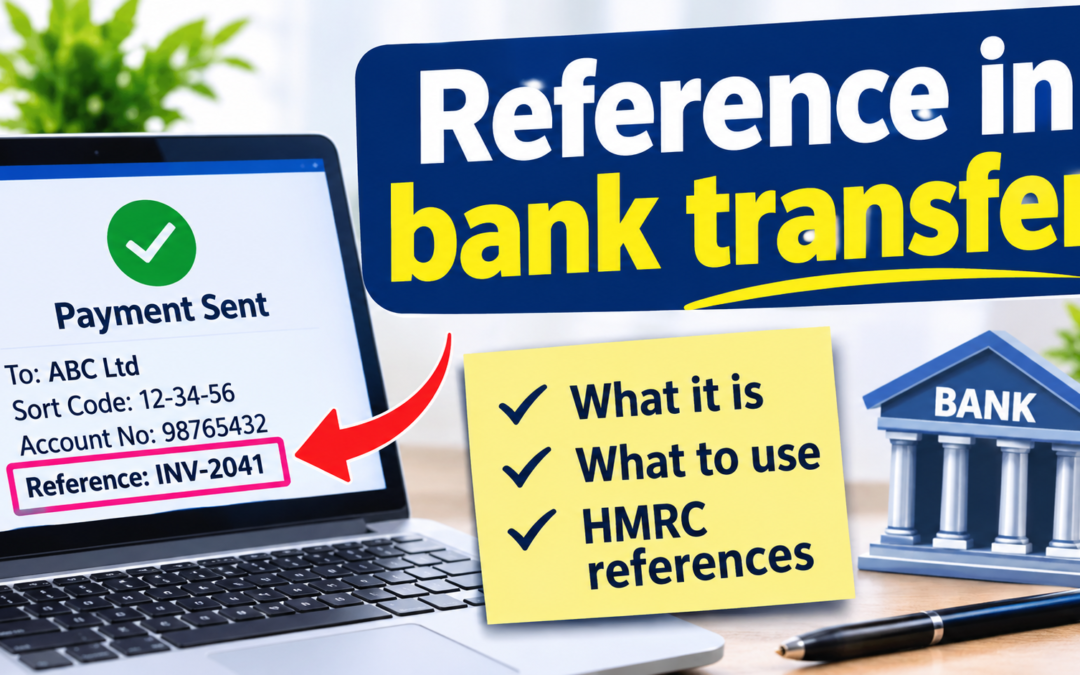
You send the money, the bank says it has gone, and a week later you get a reminder saying it was never paid. In most cases the money arrived. What went wrong was the reference in bank transfer details: it was missing, out of date or slightly wrong, so the person or organisation you paid could not match it to your account.
This guide to the reference in bank transfer payments explains what the reference is for, what to write in everyday situations, the exact payment reference HMRC expects for each tax, and what to do if you have already sent a payment with the wrong one.
- The reference is for the person receiving the money. It does not decide which account the money goes to.
- Bank transfer reference limits vary by bank and payment type, so check your app before confirming.
- HMRC uses different payment references for different taxes, including Self Assessment, VAT, Corporation Tax and PAYE, and separate X references for some penalties.
- A wrong HMRC reference can delay allocation or cause a payment to be credited to the wrong liability.
- You generally cannot edit a payment reference after sending, but the recipient may be able to trace and allocate the payment.
Bank Transfer Reference Meaning: What It Is and What It Does
When you pay someone by Faster Payment, Bacs or CHAPS, your bank asks for the payee’s name, sort code, account number and a reference. The first three tell the banking system where the money should go. The reference is different: it is a label that the receiving bank passes on, so the payee can see who paid and why.
For a friend, that label might be “Pizza Friday”. For a business or HMRC, it is usually a specific number linking the money to your invoice or tax account, which large organisations use to match thousands of payments automatically.
Reference vs remittance advice
A remittance advice is a separate message, often an email, that tells a supplier which invoices a payment covers. Businesses use it when one transfer pays several invoices and the reference field is too short to list them all.
Can Someone See Your Bank Transfer Reference?
Yes. A reference is not private, so it helps to know who sees it.
- The recipient sees it. It normally appears on the payee’s bank statement and in their accounting software, where their staff use it to match your payment.
- You may see it too. Many banks show the reference on your own statement, which is useful when you need proof of what a payment was for.
- Keep it free of sensitive details. Never put passwords, PINs, card numbers or personal details such as your date of birth in a reference.
- It is not the same as Confirmation of Payee. Confirmation of Payee compares the name you typed with the name on the receiving account. It does not check the reference, so your bank cannot tell whether a payment reference is right; only the payee can.
Reference in Bank Transfer: What to Put, With Everyday Examples
Every bank transfer reference example below follows one golden rule: if the payee has told you what to use, use exactly that. If they have not, choose something short and specific that identifies you and the purpose.
| Situation | Good reference | Avoid |
|---|---|---|
| Paying an invoice | The invoice number, e.g. INV-2041 | “Payment” or “Invoice” |
| Rent to a landlord or agent | Tenancy reference or flat number plus month, e.g. FLAT3 NOV26 | Your first name only |
| Deposit or booking | Booking number and surname | Nothing at all |
| Council Tax | Your Council Tax account number | Your address |
| Utility or phone bill | Customer account number from the bill | An old account number |
| Friend or split bill | What it was for, e.g. DINNER 6 NOV | Private details |
| HMRC tax bill | The exact payment reference for that tax (see the HMRC table) | UTR alone for VAT, or a reference from last year |
| Overseas payment | The invoice or customer number in the remittance information field | Long sentences that will be cut off |
Some organisations call it a payment reference number or customer reference; whatever the label, it is the reference number for the bank transfer. If you are unsure what to put as a bank transfer reference and the payee has not said, your surname plus an invoice or booking number is a safe default.
Reference in Bank Transfer: Character Limits
The number of characters you can enter in a UK bank transfer reference depends on your bank, the payment method and the type of transfer. Some banking apps set short limits, while international payment forms may offer a longer remittance information field.
Before sending a payment:
- Check the character limit shown in your banking app.
- Put the most important identifying information first if the field is restricted.
- Use the exact reference supplied by HMRC or the recipient.
- Avoid unnecessary symbols or spaces unless the payment instructions ask for them.
- Check that the complete reference is visible before you confirm.
Do not assume every UK bank accepts the same reference length. If an HMRC reference looks too long for your bank’s payment form, check HMRC’s payment instructions and contact your bank, rather than shortening it yourself.
HMRC Payment Reference: The Exact Format for Each Tax
HMRC is where a bank transfer reference matters most, because each tax uses its own format and its own reference. Using your UTR for VAT, or last quarter’s PAYE reference for this month, is one of the most common reasons a payment goes astray.
| Tax | Payment reference | Length | Where to find it |
|---|---|---|---|
| Self Assessment | Your 10-digit UTR followed by K, e.g. 1234567890K | 11 characters | HMRC online account or paying-in slip |
| VAT bill | Your 9-digit VAT registration number, with no GB prefix or spaces | 9 digits | VAT certificate or VAT online account |
| VAT surcharge or penalty | The separate reference starting with X, where applicable | 14 characters | The HMRC letter about the surcharge or penalty |
| Corporation Tax | The payment reference for that accounting period | 17 characters | Notice to deliver, HMRC reminder or company HMRC account |
| Employers’ PAYE | On time: 13-character Accounts Office reference. Early or late: the same plus 4 digits | 13 or 17 characters | HMRC letter when you registered as an employer; payroll software |
| PAYE late payment or filing penalty | The reference starting with X, not your Accounts Office reference | 14 characters | The penalty notice |
| P800 or Simple Assessment | The reference shown on the letter | Varies | Your P800 or Simple Assessment letter |
| AML supervision fees | The reference starting with X given in your AML payment instructions | 14 characters (per HMRC’s AML fee guidance) | Your AML supervision online account |
The details above come from GOV.UK’s pages on paying Self Assessment, Corporation Tax, employers’ PAYE, PAYE penalties, VAT and P800 tax. The AML fee reference is explained in our guide to HMRC AML supervision. Not every X reference has the same length, so always copy the one on your own letter or account.
How the PAYE 4 digits work
If you pay PAYE on time, use only your 13-character Accounts Office reference. For early or late payments, add a 4-digit suffix. The first two digits are the last two digits of the year in which the tax year ends. The last two identify the period, and the rule depends on how often you pay:
- Monthly: the tax month, where 6 April to 5 May is 01. For example, in the 2026 to 2027 tax year, a payment for 6 May to 5 June 2026 uses 2702.
- Quarterly: the tax month in which the quarter ends: 03, 06, 09 or 12. A payment for 6 April to 5 July 2026 uses 2703.
- Annual: the tax month in which you paid your employees.
Do not use the monthly suffix for quarterly or annual payments. If you pay through HMRC’s online service, it works out the digits for you.
Why Corporation Tax references change
Each accounting period has its own 17-character Corporation Tax reference. If your company pays this year’s bill with last year’s reference, the money may sit against the wrong period. Always copy the reference for the period you are paying.
HMRC has several bank accounts, such as HMRC Cumbernauld, HMRC Shipley and HMRC VAT, and they are not the same for every tax. Take the bank details from the GOV.UK page for the tax you are paying, not from an old payment in your app.
For VAT deadlines and how long each payment method takes, see our guide to VAT payment dates.
Wrong Reference in Bank Transfer? What to Do
If you entered the wrong reference but the bank account details were correct, the payment has probably reached the intended recipient. However, it could remain unallocated or be credited against another liability. A wrong reference bank transfer is usually fixable, but only once the recipient knows about it.
Contact the recipient, or HMRC, as soon as possible and give them:
- the payment date
- the amount transferred
- the bank account you paid into
- the reference you entered
- the correct reference
- your relevant tax or customer account details
Keep your payment confirmation until the recipient confirms the money has been allocated correctly. If you sent the money to the wrong bank account, contact your bank immediately. That is a different, more urgent problem from using an incorrect payment reference.
| Who you paid | What usually happens | What to do |
|---|---|---|
| HMRC | The payment may be delayed, held unallocated or used to pay a different tax you owe | Contact the HMRC helpline for that tax and ask for the payment to be moved |
| A supplier or landlord | They see money arrive but cannot match it | Email them the date, amount and the invoice or tenancy it was for |
| A friend or family member | Nothing serious | Send a quick message to explain |
| The wrong account altogether | The money has gone to someone else | Call your bank straight away and ask it to try to recover the payment |
HMRC’s own research on payments that needed manual allocation, published in 2023, found the main causes were missing, incomplete or wrong references. Common mistakes included banking apps auto-filling an old reference, long references copied by hand from a letter, and not realising a reference was needed at all.
The same research noted that online banking cannot check whether an HMRC reference is valid. Paying through your HMRC online account or the HMRC app, where the reference is filled in for you, avoids most of these problems.
Changing a reference after sending
Usually not. Once a Faster Payment has been sent, the reference in bank transfer details travels with it and cannot be edited. The fix is to contact the payee, not your bank, unless the account details themselves were wrong.
Standing Orders, Direct Debits and International Transfers
Standing orders
A standing order repeats the same reference every time. That is ideal for rent or a fixed savings transfer, but risky for HMRC. A PAYE standing order, for example, would need its 4 extra digits updated for early or late payments, and a Corporation Tax reference changes for every accounting period. If you use a standing order, review the reference whenever the period changes.
Direct Debits
With a Direct Debit, the organisation collecting the money manages the payment reference, so you do not normally enter one. The statement description depends on the type of HMRC payment: Corporation Tax Direct Debits appear as HMRC NDDS, while employers’ PAYE Direct Debits appear as HMRC SDDS. Check that the right tax account and payment arrangement are set up before the collection date.
International transfers
Payments in euros or other currencies often use a longer “remittance information” or “payment details” field instead of a short reference. If you are paying HMRC from abroad, use the same reference as a UK payment and the IBAN and BIC shown on GOV.UK for that tax. Some banks charge if you do not pay in pounds sterling.
For Businesses: Make References Work for You
If you run a business, the reference in bank transfer payments is not just about paying others. References decide how quickly you can match money coming in, which matters even more under Making Tax Digital.
- Put a clear reference on every invoice, such as “Please use INV-2041 as your reference”.
- Give regular customers a fixed customer ID they can reuse, so recurring payments match automatically.
- Ask for remittance advice when one payment covers several invoices.
- Keep your own outgoing references consistent, for example supplier name plus invoice number.
Most MTD software connects to your bank feed and suggests matches based on the amount and reference. Clean references mean fewer manual matches, faster VAT returns and fewer errors. Our guide to MTD for VAT explains how digital records and bank feeds fit together.
Payment References and Scams
Fraudsters send texts and emails that look like they come from HMRC or a bank, with a “payment reference” and bank details to pay. The reference makes the message look official, but it proves nothing.
- Never put passwords, PINs or full card numbers in a reference field.
- Only pay HMRC using bank details from GOV.UK or your HMRC online account.
- Be wary of any message that changes a supplier’s bank details. Call them on a number you already have to confirm.
- If Confirmation of Payee warns that the name does not match, stop and check before sending.
If you are tricked into sending money through an eligible authorised push payment (APP) scam, you may be entitled to reimbursement under the Payment Systems Regulator’s rules. The limit for eligible Faster Payments APP scam claims is generally £85,000 per claim, and payment firms may apply an excess of up to £100, subject to the rules and the protections for vulnerable customers.
Eligibility requirements and exclusions apply. Contact your bank immediately if you think you have been scammed.
Checklist Before You Press Send
- Is the payee name exactly as given, and did Confirmation of Payee match?
- Are the sort code and account number taken from a trusted source?
- Is the reference exactly what the payee asked for?
- For HMRC, is it the right reference for this tax and this period?
- Does the reference fit without being cut off?
- Have you kept a screenshot or note of the payment for your records?
How MTDFix Can Help
If chasing HMRC references, payment dates and bank matching is taking up your time, MTDFix can handle your MTD-compatible VAT returns and quarterly updates, and tell you exactly what to pay and when.
Reference in Bank Transfer FAQs
What should I put as the reference in a bank transfer?
Use exactly what the payee asks for, such as an invoice number, account number or HMRC payment reference. If they have not said, use something short that identifies you and the purpose, such as your surname and invoice number.
Is the payment reference the same as the account number?
No. The account number and sort code decide where the money goes. The reference is a label for the payee. Some organisations ask you to use your customer account number as the reference, but it is entered in the reference field.
What happens if I put the wrong reference?
The money still reaches the account, but the payee may not match it to you. With HMRC, the payment may be delayed or used against another tax. Contact the payee with the date, amount and correct details.
Can I change a bank transfer reference after sending?
Usually not. Once sent, the reference cannot be edited. Tell the payee what the payment was for so they can allocate it correctly.
What is my HMRC payment reference?
It depends on the tax. Self Assessment uses your UTR plus K, VAT uses your 9-digit VAT number, Corporation Tax uses a 17-character reference for each period, and PAYE uses your Accounts Office reference, plus 4 digits for early or late payments.
How many characters can a bank transfer reference have?
It depends on your bank, the payment method and the type of transfer. Check the limit shown in your banking app, and never shorten an HMRC reference yourself.
Does the reference have to match the payee name?
No. Confirmation of Payee checks the account name, not the reference. The reference only needs to be what the payee asked for.
Final Word: Getting the Reference in Bank Transfer Payments Right
The reference in a bank transfer is a small field with big consequences. Use what the payee asks for, keep it short, and for HMRC, use the exact reference for that tax and period. If you get it wrong, the money is rarely lost, but you will need to tell the payee so they can put it in the right place.
Written by Shamayun Chowdhury, with every HMRC payment reference checked against GOV.UK in November 2026. For a wider list of UK tax numbers, see Eternity Accountants’ guide to what a reference number is. No separate technical reviewer is named. This guide is general information, not advice for your circumstances.