
By Shamayun Chowdhury, Senior Accountant, Major Accountancy · Published: 8 November 2026 · Last reviewed: November 2026 · 2026/27 tax year
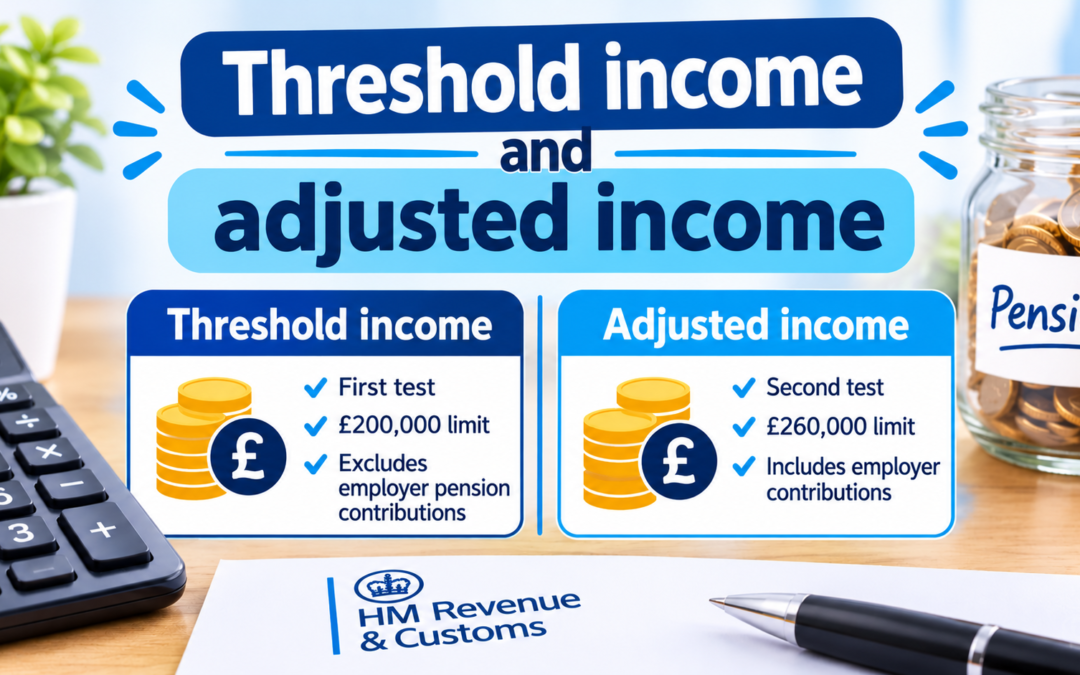
Threshold income and adjusted income are two measures HMRC uses to decide whether your £60,000 pension annual allowance is reduced. The taper only applies if your threshold income is over £200,000 and your adjusted income is over £260,000. The key difference: threshold income leaves out employer pension contributions, while adjusted income adds them back in.
If you earn a high income, you may have been told to check your threshold and adjusted income before paying into a pension. The names sound alike, the rules are written for pension specialists, and getting them wrong can mean a surprise tax charge on your Self Assessment return.
This guide does one job: it explains what each measure means, what goes in and what stays out, and how to work both out step by step. It finishes with five worked examples for employees, company directors, landlords and sole traders. If the taper does apply to you, our sister guide to the tapered annual allowance covers the charge, scheme pays and carry forward.
- The standard pension annual allowance is £60,000 for 2026/27.
- If your threshold income is £200,000 or less, the taper cannot apply, whatever your adjusted income.
- Above £260,000 of adjusted income, the allowance falls by £1 for every £2, down to a minimum of £10,000.
- Employer contributions count towards adjusted income, but not threshold income.
- Salary sacrifice set up after 8 July 2015 is added back to threshold income, so it cannot be used to get under £200,000.
What Are Threshold income and adjusted income?
Both measures start from the same place, your net income for the tax year, and then adjust it in different ways for pension savings. GOV.UK sets out the method in its guidance on how to work out your tapered annual allowance.
Threshold income meaning
Threshold income is broadly your taxable income for the year after deducting the pension contributions you make personally through relief at source. It is the first test. If it is £200,000 or less, you stop: your annual allowance is not tapered.
Adjusted income meaning
Adjusted income is broadly your taxable income plus all pension savings made through your employer, including employer contributions and contributions taken from your pay before tax. It is the second test, and it decides how much the allowance is reduced if the first test is passed.
Why there are two tests
The two tests exist to stop people avoiding the taper by rearranging their pay. Employer contributions are left out of threshold income so that ordinary employees with generous pensions are not caught, but they are added to adjusted income so that very high earners cannot shelter pay as pension contributions without the allowance being reduced.
Threshold Income vs Adjusted Income vs Adjusted Net Income
Three similar-sounding measures are used for very different rules. Mixing them up is one of the most common errors.
| Measure | Used for | Key limit |
|---|---|---|
| Threshold income | First test for the tapered annual allowance | £200,000 |
| Adjusted income | Second test, and the size of the taper | £260,000 |
| Adjusted net income | Personal Allowance taper and High Income Child Benefit Charge | £100,000 for the Personal Allowance; £60,000 to £80,000 for the Child Benefit charge |
| Net income | The starting point for all of the above | — |
Adjusted net income is a separate calculation used for the Personal Allowance and the High Income Child Benefit Charge. It is not the same as adjusted income, even though only one word is different.
If your threshold income is £200,000 or less, the tapered annual allowance does not apply to you. You do not need to calculate adjusted income at all.
What Counts: The In and Out Table
This table shows how common types of income and pension saving are treated. Use it alongside the steps below.
| Item | Threshold income | Adjusted income |
|---|---|---|
| Salary, bonus and benefits in kind | In | In |
| Dividends, rental profit, trading profit, savings interest | In | In |
| Your personal contributions under relief at source (gross) | Deducted | Not deducted |
| Your contributions through a net pay arrangement | Already excluded from pay | Added back |
| Employer pension contributions | Out | Added |
| Salary sacrifice for pension set up after 8 July 2015 | Added back | Included as employer contribution |
| Lump sum death benefits from a registered scheme | Deducted | Deducted |
How to Work Out Threshold and Adjusted Income: Step by Step
Follow these steps in order. They summarise GOV.UK’s method and HMRC’s Pensions Tax Manual.
Step 1: Work out your net income
Add up all your taxable income for the tax year: earnings, self-employed profits, most pension income, most savings interest, dividends, rental income and certain trust income. Then deduct any tax reliefs you have claimed on payments made before relief was given, such as some pension contributions you claim relief on directly.
Step 2: Work out threshold income
- Start with net income.
- Deduct the gross amount of pension contributions made by you, or by someone other than your employer, under relief at source.
- Deduct any lump sum death benefits you received from registered pension schemes.
- Add back any pay you gave up for pension provision under salary sacrifice or flexible remuneration arrangements made after 8 July 2015.
Step 3: Work out adjusted income
- Start with net income.
- Add any pension contributions taken from your pay before tax (net pay arrangements).
- Add any pension contributions you claimed relief on directly, and relief on overseas scheme contributions.
- Add your employer’s pension contributions, or for a defined benefit scheme, the employer element of your pension input amount.
- Deduct any lump sum death benefits from registered pension schemes.
Step 4: Apply the tests
- If threshold income is £200,000 or less, there is no taper.
- If threshold income is over £200,000 and adjusted income is over £260,000, reduce the £60,000 allowance by £1 for every £2 of adjusted income above £260,000.
- The reduced allowance cannot fall below £10,000.
Adjusted income for pension savings in a defined benefit scheme
If you are in a defined benefit (final salary or career average) scheme, there is no simple employer contribution figure to add. Instead, your pension input amount is worked out by valuing your pension at the start and end of the year, using a factor of 16, and adjusting the opening value for inflation. The employer element of that growth is added to adjusted income.
Your scheme should send a pension savings statement if your savings in that scheme are over the standard allowance, or if you ask for one. NHS consultants, senior civil servants and long-serving staff with pay rises are the people most often surprised by this part of the calculation.
Where to Find Each Figure
| Figure | Where to find it |
|---|---|
| Salary, bonus and tax paid | P60, final payslip or your HMRC personal tax account |
| Benefits in kind | P11D or payrolled benefits on your payslip |
| Dividends, interest, rental and trading profit | Your Self Assessment return or accounts |
| Personal pension contributions | Pension provider annual statement |
| Employer contributions | Pension statement or payslip; for directors, company accounts |
| Defined benefit savings | Your scheme’s pension savings statement |
Under Making Tax Digital for Income Tax, sole traders and landlords send quarterly updates, but those are not final figures. Use the year-end profit from your tax return, not your quarterly totals. Our guide to MTD deadlines explains when MTD applies to you.
Five Worked Examples by Income Type
These threshold and adjusted income examples are illustrations for 2026/27, worked out by us. They assume no lump sum death benefits and no unused allowance from earlier years.
Example 1: Employee with a bonus
Priya earns a £210,000 salary and a £30,000 bonus, so her net income is £240,000. She pays £20,000 gross into a personal pension under relief at source, and her employer contributes £30,000.
- Threshold income: £240,000 − £20,000 = £220,000, so over £200,000.
- Adjusted income: £240,000 + £30,000 = £270,000, so £10,000 over £260,000.
- Reduction: £10,000 ÷ 2 = £5,000. Her annual allowance is £55,000.
Example 2: Company director with salary and dividends
Tom takes a £12,570 salary and £200,000 of dividends from his company, which pays £60,000 into his pension as an employer contribution. His net income is £212,570.
- Threshold income: £212,570. Employer contributions are not counted.
- Adjusted income: £212,570 + £60,000 = £272,570.
- Reduction: £12,570 ÷ 2 = £6,285, so his allowance is £53,715, and the £60,000 contribution is £6,285 over it unless he has unused allowance to carry forward.
If Tom took £185,000 of dividends instead, his threshold income would be £197,570. That is under £200,000, so the taper would not apply and his full £60,000 allowance would be available. This is why directors often plan dividends and employer contributions together.
Example 3: Landlord with a job
Sarah earns £150,000 from employment, makes £70,000 of rental profit and receives £5,000 of interest, a net income of £225,000. She pays £10,000 gross into a personal pension and her employer adds £15,000.
- Threshold income: £225,000 − £10,000 = £215,000.
- Adjusted income: £225,000 + £15,000 = £240,000.
- Adjusted income is under £260,000, so there is no taper. Her allowance stays at £60,000.
Example 4: Sole trader with uneven profits
Dev expects a £255,000 profit and pays £40,000 gross into a personal pension during the year. On that estimate, threshold income is £215,000 and adjusted income is £255,000, so there is no taper.
When his accounts are finished after 5 April, the profit is actually £290,000. Threshold income becomes £250,000 and adjusted income £290,000. The reduction is £15,000, so his allowance falls to £45,000. His £40,000 contribution is still within it, but a larger payment could have triggered a charge he could not see coming.
Example 5: Employee using salary sacrifice
Aisha’s salary is £230,000, but she sacrifices £30,000 into her pension under an arrangement set up in 2024, so her taxable pay is £200,000. Her employer also pays a regular £10,000.
- Threshold income: £200,000 + £30,000 added back = £230,000.
- Adjusted income: £200,000 + £40,000 employer contributions = £240,000.
- Adjusted income is under £260,000, so there is no taper, but the salary sacrifice did not help her get under the £200,000 threshold.
| Example | Threshold income | Adjusted income | Taper? | Annual allowance |
|---|---|---|---|---|
| 1 Employee with bonus | £220,000 | £270,000 | Yes | £55,000 |
| 2 Director | £212,570 | £272,570 | Yes | £53,715 |
| 3 Landlord with job | £215,000 | £240,000 | No | £60,000 |
| 4 Sole trader (final profit) | £250,000 | £290,000 | Yes | £45,000 |
| 5 Salary sacrifice | £230,000 | £240,000 | No | £60,000 |
Keeping Threshold Income Under £200,000: What Can Make a Difference
This is not advice, but these are the levers people commonly discuss with their accountant or adviser when threshold and adjusted income are close to the limits:
- Personal contributions under relief at source reduce threshold income pound for pound, gross.
- Gift Aid donations extend your basic rate band and are deducted in working out net income.
- Dividend timing for directors, since dividends count in the year they are paid.
- Employer contributions for directors, which are left out of threshold income but count in adjusted income.
- Carry forward of unused allowance from the previous three years if a taper does bite.
Salary sacrifice set up after 8 July 2015 does not help with threshold income, because it is added back. Always check the figures for the whole tax year, 6 April to 5 April, rather than a single payslip. If you are close to either limit, it is worth running the threshold and adjusted income numbers before the end of the tax year, while there is still time to act.
How the Limits Have Changed
Older articles often quote limits that no longer apply. GOV.UK’s 2020 policy paper and current guidance show how they have moved:
| Tax years | Threshold income | Adjusted income | Minimum allowance |
|---|---|---|---|
| 2016/17 to 2019/20 | £110,000 | £150,000 | £10,000 |
| 2020/21 to 2022/23 | £200,000 | £240,000 | £4,000 |
| 2023/24 onwards | £200,000 | £260,000 | £10,000 |
Common Mistakes
| Mistake | Why it matters | Better approach |
|---|---|---|
| Confusing adjusted income with adjusted net income | Different rules and different limits | Use the right measure for each test |
| Forgetting employer contributions in adjusted income | Taper understated | Check your pension statement |
| Assuming salary sacrifice lowers threshold income | Post-2015 sacrifice is added back | Plan with the add-back in mind |
| Using quarterly MTD figures as final profit | Profit may be higher at year end | Estimate cautiously and review after 5 April |
| Using pre-2023/24 limits | Wrong answer | Use £200,000 and £260,000 |
What to Do If the Taper Applies
If your contributions are above your reduced allowance, you may be able to use unused allowance from the previous three tax years. Any excess is reported on your Self Assessment return and taxed at your marginal rate, and in some cases your pension scheme can pay the charge for you. These steps are explained in our sister guide to the tapered annual allowance and on GOV.UK’s annual allowance page.
How MTDFix Can Help
MTDFix handles MTD quarterly updates and year-end returns for sole traders and landlords, so you have reliable profit figures earlier in the year and fewer surprises when you work out threshold and adjusted income.
Threshold and Adjusted Income FAQs
What is threshold income?
It is your net income for the tax year minus the gross pension contributions you make personally under relief at source and any lump sum death benefits, plus any salary sacrifice for pension arranged after 8 July 2015.
What is adjusted income?
It is your net income plus pension savings made through your employer, including employer contributions and net pay contributions, minus any lump sum death benefits.
Are employer pension contributions included?
Not in threshold income, but yes in adjusted income.
Does salary sacrifice reduce threshold income?
Not for arrangements made after 8 July 2015. The pay you give up is added back when you work out threshold income.
Are dividends included?
Yes. Dividends, rental profit, trading profit and savings interest all count towards net income, so they feed into both measures.
Is adjusted income the same as adjusted net income?
No. Adjusted income is used for the pension taper. Adjusted net income is used for the Personal Allowance taper above £100,000 and the High Income Child Benefit Charge.
Do I need to calculate it if I earn under £200,000?
If your threshold income is £200,000 or less, the taper does not apply, so you do not need to work out adjusted income for this purpose.
Final Word on Threshold and Adjusted Income
Threshold and adjusted income are two steps in one question: is your pension allowance reduced? Check threshold income first; if it is £200,000 or less, you are done. If not, add back employer and net pay contributions to find adjusted income, and only then work out any taper. For directors, landlords and the self-employed, the real risk is timing, so estimate early and review your figures once the year has closed.
MTDFix works with sole traders, landlords and company directors on MTD submissions and Self Assessment.
✓ Self Assessment for directors and landlords
✓ Fixed fees, agreed before we start
Written by Shamayun Chowdhury, with every step checked against GOV.UK and HMRC’s Pensions Tax Manual in November 2026. The worked examples use invented names and our own calculations. No separate technical reviewer is named. This guide is general information, not financial advice; speak to a regulated adviser before changing pension contributions.